Acrylic, Nano-Ceramic, or Zirconia? Choosing Your Prosthetic Superstructure
Drawing BIO-ENG-006 marks the point where the "Engineered for Life" deck stops talking about bone and starts talking about the surface you actually live with. Once the implant posts have fused into the jaw, a prosthetic superstructure is fixed over them, and it comes in three grades: acrylic with a titanium bar, nano-ceramics, and zirconia. Each one handles load, wear, and light differently, and the choice quietly reshapes what your reconstruction costs across 25 years.
Reading the superstructure as a load path
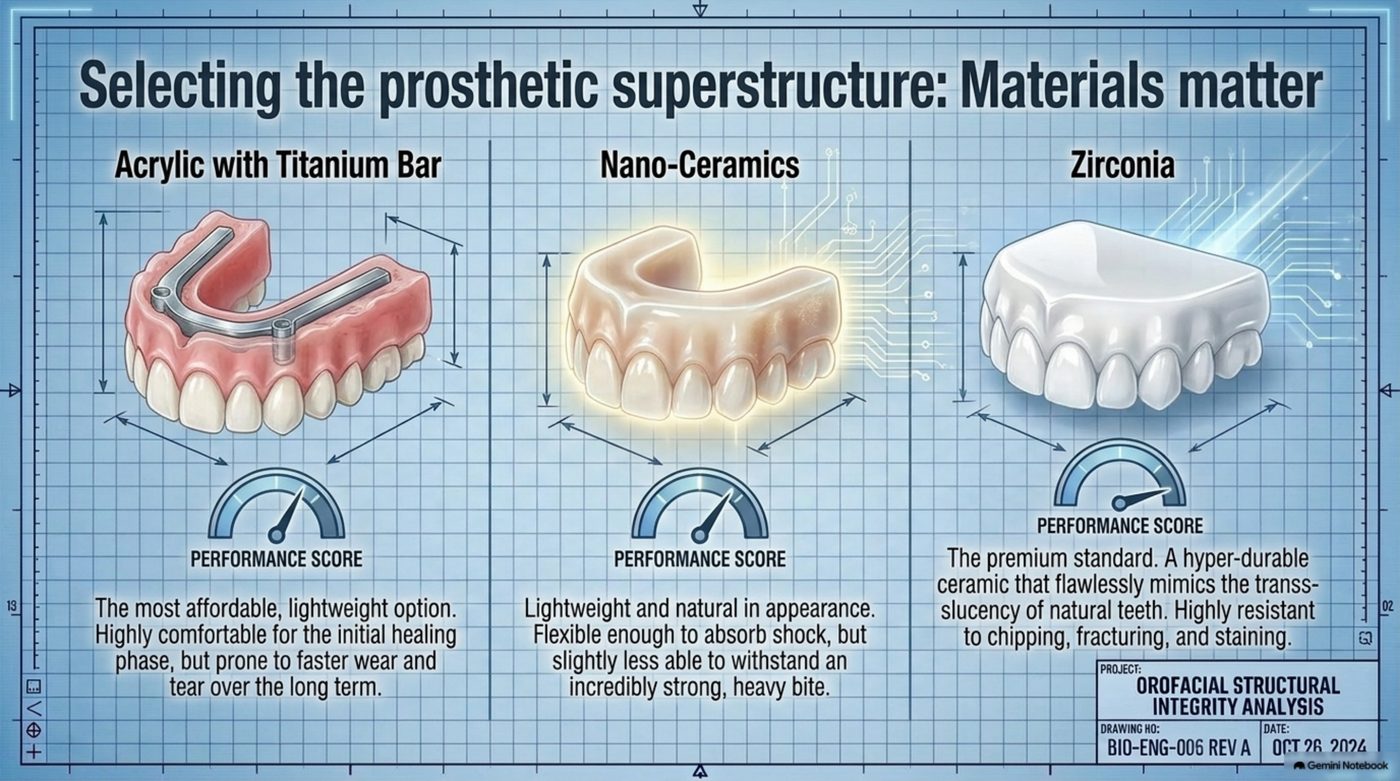
The deck's Orofacial Structural Integrity Analysis treats the reconstruction the way an engineer treats a bridge: forces enter at one end and have to be carried safely to the other. Your chewing muscles drive load into the superstructure first, so that layer spreads and distributes the bite before passing it to the titanium posts, which pass it into bone. If the superstructure is too rigid, stress concentrates in one region. If it is too flexible, it deforms and fatigues. Each material sits at a different point along that trade-off, which is why the drawing scores them separately.
Acrylic with a titanium bar: the accessible workhorse
Acrylic with a titanium bar is described in the deck as the most affordable, lightweight option. It is the only one of the three that carries a cost advantage as part of its identity, and it earns a genuine clinical one as well: it is highly comfortable for the initial healing phase, when the tissue around the arch is still adapting to new hardware. The titanium bar inside gives it a structural backbone, while the acrylic provides a forgiving, easily adjusted surface. The limitation is stated just as plainly. Acrylic is prone to faster wear and tear over the long term, which means the surface material is a component with a shorter service interval than the metal underneath it. For a patient who needs a functioning arch quickly and wants to keep the initial outlay down, it is a rational starting point, provided you plan for that wear.
Nano-ceramics: the premium standard
Nano-ceramics occupy the top of the deck's hierarchy: the premium standard, a hyper-durable ceramic that flawlessly mimics the translucency of natural teeth. Translucency is what makes a restoration read as a tooth rather than a block, and it is the hardest thing to fake. The mechanical case is just as strong. The material is highly resistant to chipping, fracturing, and staining, which addresses the three failure modes that drive most prosthetic repairs. In load terms, it sits at the rigid end of the spectrum: stiff enough to hold its shape under heavy biting forces, hard enough to resist the abrasion that slowly grinds softer surfaces away. The trade-off is cost, plus the fact that a hard wear surface transfers more of the shock to whatever sits beneath it.
Zirconia: light, natural, and shock-absorbing
Zirconia gets a description that sounds like a compromise but is really a different design goal. It is lightweight and natural in appearance, and it is flexible enough to absorb shock, which makes it comfortable against opposing teeth and forgiving of the sudden loads that come with an accidental hard bite. The deck is precise about its limit: it is slightly less able to withstand an incredibly strong, heavy bite. That flexibility is a feature with a ceiling: it buys shock absorption at the cost of peak load tolerance, so it suits patients whose biting forces fall within a normal range.
The trade-offs, side by side
| Superstructure | Cost position | Standout property | Main limitation |
|---|---|---|---|
| Acrylic with titanium bar | Most affordable | Lightweight; highly comfortable during the initial healing phase | Prone to faster wear and tear over the long term |
| Nano-ceramics | The premium standard | Hyper-durable; mimics the translucency of natural teeth; resistant to chipping, fracturing, and staining | The most rigid surface of the three |
| Zirconia | Premium | Lightweight and natural in appearance; flexible enough to absorb shock | Slightly less able to withstand an incredibly strong, heavy bite |
Read down the columns and the logic of the drawing becomes clear. Every material trades one property for another: cost against longevity, rigidity against shock absorption, wear resistance against flexibility. Four variables do the trading. Flex versus rigidity decides how the arch handles a sudden load. The wear surface decides how often the material has to be serviced. Translucency decides whether the result looks like teeth or like hardware. And load tolerance decides the ceiling on what the reconstruction can safely take. The deck does not rank these as good, better, best. It ranks them as different answers to the same question. If you want to see how the superstructure fits into the wider decision, the full-arch options comparison matrix lays the choices out end to end.
How material choice shifts the 25-year economics
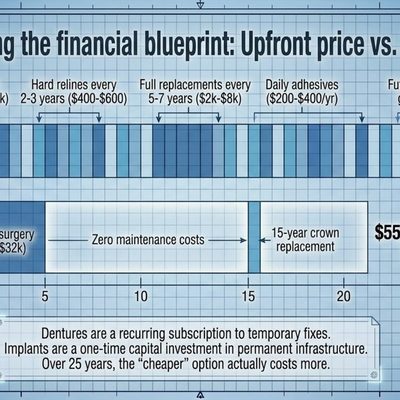
The material you select on this slide follows you into slide 8's cost model. A softer surface that is prone to faster wear and tear implies more frequent maintenance, and maintenance is precisely what compounds over a 25-year horizon. A harder, stain-resistant ceramic pushes that wear years into the future, which is the substance behind the premium label. You can see how your own numbers land using our dental cost benchmark table, and for the long view, the 25-year cost of ownership comparison puts recurring costs beside the one-time investment. Whichever grade you choose, the arch has to be planned for the bone that supports it, which is why provider selection matters as much as the material; start with how a full-arch reconstruction is planned in full mouth dental implants in Cape Coral.
Frequently asked questions
Is acrylic with a titanium bar a low-quality choice?
No, and the deck does not frame it that way. It is the most affordable and lightweight option and is highly comfortable for the initial healing phase. Its known weakness is faster wear and tear over the long term, so the honest way to treat it is as a surface with a shorter service life, not a failed product. If your priority is a functioning arch at the lowest initial cost, it does the job it was designed to do.
Does a harder ceramic protect my implants?
Hardness protects the restoration's surface, not automatically the structures below it. Nano-ceramics are highly resistant to chipping, fracturing, and staining, which reduces surface failure. Zirconia's flexibility, by contrast, absorbs shock and so is gentler on opposing teeth. Neither property is universally better. What matters is matching the material to your biting forces and to the condition of the bone and implants underneath, which is a judgment your provider makes from your own scans and bite.
How do I know which superstructure suits me?
The right answer comes from your load profile, your priorities, and your budget, not from a single best material. A patient with very heavy biting forces and a taste for durability should weigh the nano-ceramic option heavily, while someone who values natural feel and shock absorption within a normal bite range may prefer zirconia, and a patient focused on initial cost may choose acrylic over titanium. Bring the trade-offs on this slide to a consultation and ask which material your own case points toward.
Choosing a superstructure is really choosing which engineering compromise you can live with for decades. The deck's recommendation is not a single material but a process: understand the load path, name your priority, and price the consequences over the full term instead of the first invoice. When you are ready to talk it through with someone who works with these materials every week, get matched with Cape Coral providers at no cost and no obligation, and ask which grade fits the bite you actually have.
This guide expands slide 07 of Engineered for Life: The Biomechanics and Economics of Dental Implants
For the complete slide-by-slide narrative, read the full deck walkthrough.