Dentures vs. Traditional Implants vs. All-on-4: A Three-Way Comparison
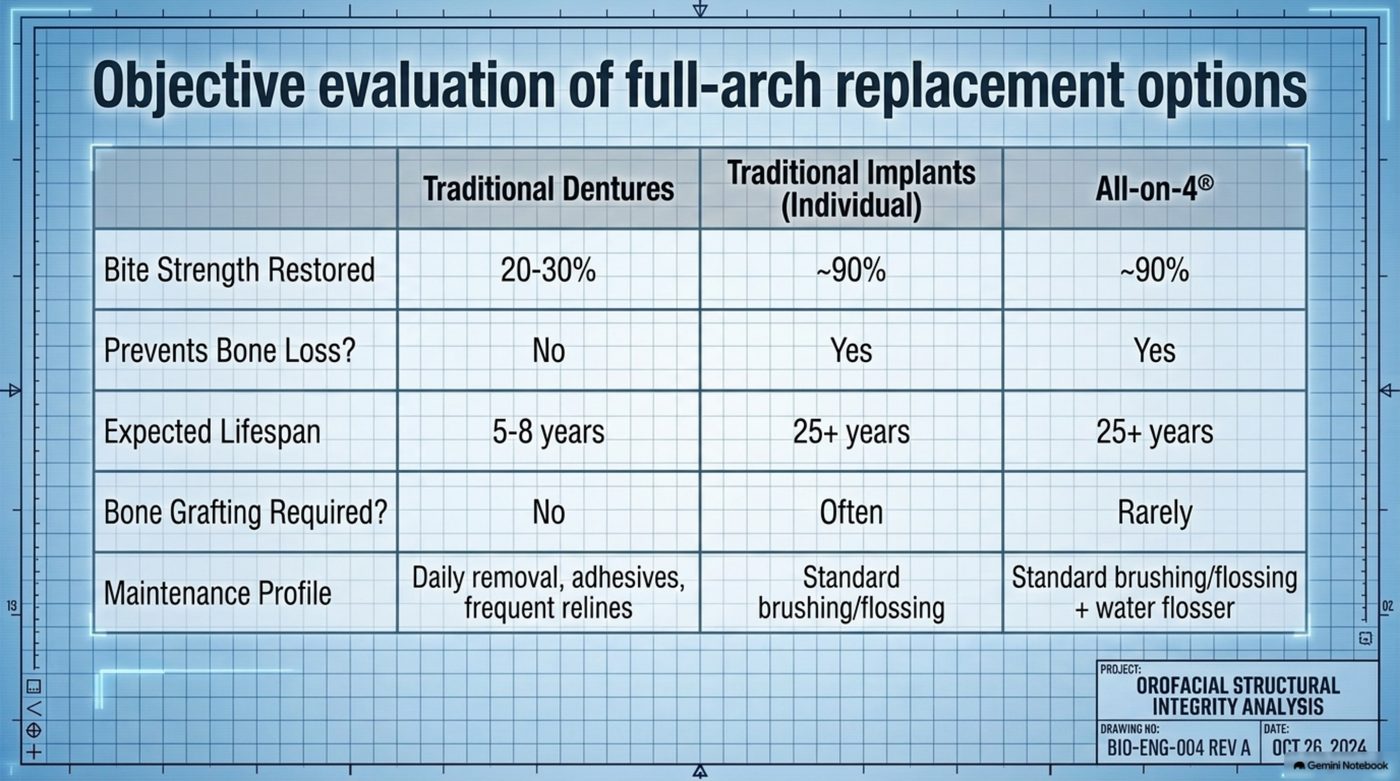
Full-arch tooth replacement is usually sold as a two-way choice between dentures and implants, but drawing BIO-ENG-004 (revised Oct 26, 2024) puts three architectures on the page. Traditional dentures, individual implants and All-on-4 are three different structural systems, and they behave differently across the five measurements that decide how well you eat and how much jawbone remains twenty years from now.
Three Columns, Three Different Structures
The matrix compares Traditional Dentures, Traditional Implants placed as individual units, and All-on-4. These are not three price points on one product. A denture is a removable prosthesis resting on the gums. Individual implants replace teeth one at a time, each with its own titanium post fused into the jaw, its own abutment and its own crown. All-on-4 carries a complete arch on fewer posts, angled on purpose.
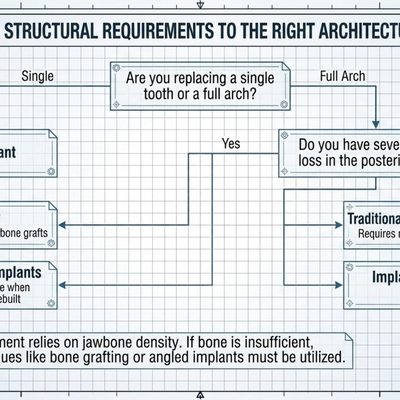
Read the columns as three systems rather than three brands and the rows stop looking like marketing copy. Each one is a consequence of how load is carried. If you are still deciding whether you need a full arch at all, our decision map for full arch versus single tooth replacement works through that earlier fork.
Row One: Bite Strength Restored
This is the row patients feel first, because it decides whether dinner needs planning. Dentures restore 20-30% of natural bite strength, and the shortfall is not cosmetic. Most of the force you generate is absorbed by acrylic and the gum tissue beneath it instead of reaching food, so the diet narrows whether you intend it to or not.
Both implant columns read about 90%, and they match for structural reasons. A denture transfers load to soft tissue; an implant transfers it through titanium into bone. Once force travels through a fused post, it arrives at the food with roughly the bite you remember. Because the two implant columns tie here, this row cannot be the one that separates them.
Row Two: Preventing Bone Loss
This row carries the longest consequences, and it is the one patients rarely raise in a consultation. A denture sits on top of the gums and delivers no stimulation to the bone beneath it, so the matrix answers No. Both implant approaches answer Yes, because the post is integrated into the jaw and loads it the way a natural root once did.
The translation for someone deciding is practical. With dentures the foundation itself keeps changing, which is why a denture that fit well five years ago can stop fitting well without anyone doing anything wrong. With either implant option, the foundation is maintained rather than progressively lost.
Row Three: Expected Lifespan
Dentures are listed at 5-8 years. Both implant approaches are listed at 25+ years. Read lifespan as a replacement cycle rather than a durability boast. A denture on a 5-8 year clock is a recurring cost and disruption, and each replacement lands on top of whatever bone change has happened since the last one.
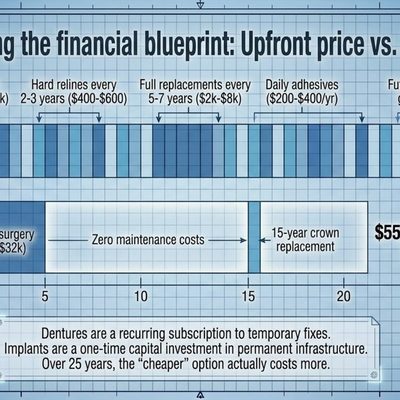
One column is a series of temporary fixes that must be renewed; the other two are closer to a single fixture with routine upkeep. The arithmetic between those two models over a lifetime is covered in our breakdown of dentures versus implants on a 25-year total cost of ownership.
Row Four: Is Bone Grafting Required
Here the two implant columns finally separate. Individual implants require grafting Often, because each post needs adequate bone at its own location, and a site empty for years may not have it. All-on-4 requires it Rarely, and that is a design outcome rather than luck: the posterior posts are angled to reach denser bone and steer clear of the structures that would otherwise force a graft.
Do not misread the denture column, which reads No. Dentures need no graft because they do not anchor into bone at all, and they do not stop bone from receding once in place. The No in this row sits directly beneath the No in the row above it.
| Consideration | Traditional Dentures | Traditional Implants (Individual) | All-on-4 |
|---|---|---|---|
| Bite strength restored | 20-30% | ~90% | ~90% |
| Prevents bone loss? | No | Yes | Yes |
| Expected lifespan | 5-8 years | 25+ years | 25+ years |
| Bone grafting required? | No | Often | Rarely |
| Maintenance profile | Daily removal, adhesives, frequent relines | Standard brushing/flossing | Standard brushing/flossing + water flosser |
Row Five: Maintenance Profile
Maintenance decides whether a choice survives contact with an ordinary morning. Dentures call for daily removal, adhesives and frequent relines. Individual implants and All-on-4 both call for standard brushing and flossing, with All-on-4 adding a water flosser to clean the tight spaces around the abutments.
From the patient's side of the mirror the implant columns look nearly identical: brush, floss, keep your professional cleanings. What differs is how much hardware you clean around and the technique it takes, which is a conversation for your surgeon rather than a line in a table. Dentures are a device you manage and remove; implants are maintained the way teeth are.
How to Use This Matrix in a Consultation
Treat the matrix as a set of trade-offs, not a scoreboard. If bite force and bone preservation top your list, the denture column falls away quickly and the real question becomes which implant architecture fits the jaw you actually have. The three columns are not quality tiers; they are three answers to where load goes, which is why the same person can be a strong candidate for one and a poor one for another.
To see how your own situation lands on these five rows, run the numbers through the implant versus denture comparison tool. When you are ready to line up real quotes, the Cape Coral full mouth implant comparisons page sets the options side by side in one place.
Frequently asked questions
Does All-on-4 really match individual implants for bite strength?
On this matrix, yes. Both columns list roughly 90% of natural bite strength restored, because both load the jaw through titanium posts fused into bone rather than through soft tissue. The difference is not how much force the system can take, but how many posts carry it and how they are positioned.
Why does bone loss prevention matter if a denture can simply be remade?
Because a remake does not restore what was lost. A denture provides no stimulation to the bone beneath it, so the foundation keeps changing between replacements. Remaking a denture adjusts the appliance to a jaw that has already changed, and that ongoing change is what nothing can undo.
Is bone grafting always required with individual implants?
The matrix says Often, not always. Each individual post needs enough bone at its own site, and sites empty for a while sometimes do not have enough. All-on-4 reads Rarely because the angled posts reach denser bone and avoid the structures that would otherwise call for a graft.
Five rows, three architectures, and one conclusion worth carrying into a consultation: only two of the three columns are designed to protect the foundation you still have. The next step is finding out which of these rows is genuinely available to you, and that starts with getting matched with Cape Coral providers at no cost and with no obligation. A call to (239) 341-0888 works if that is easier than a form.
This guide expands slide 05 of Engineered for Life: The Biomechanics and Economics of Dental Implants
For the complete slide-by-slide narrative, read the full deck walkthrough.