Upfront Price vs. 25-Year Cost of Ownership: Dentures and Implants
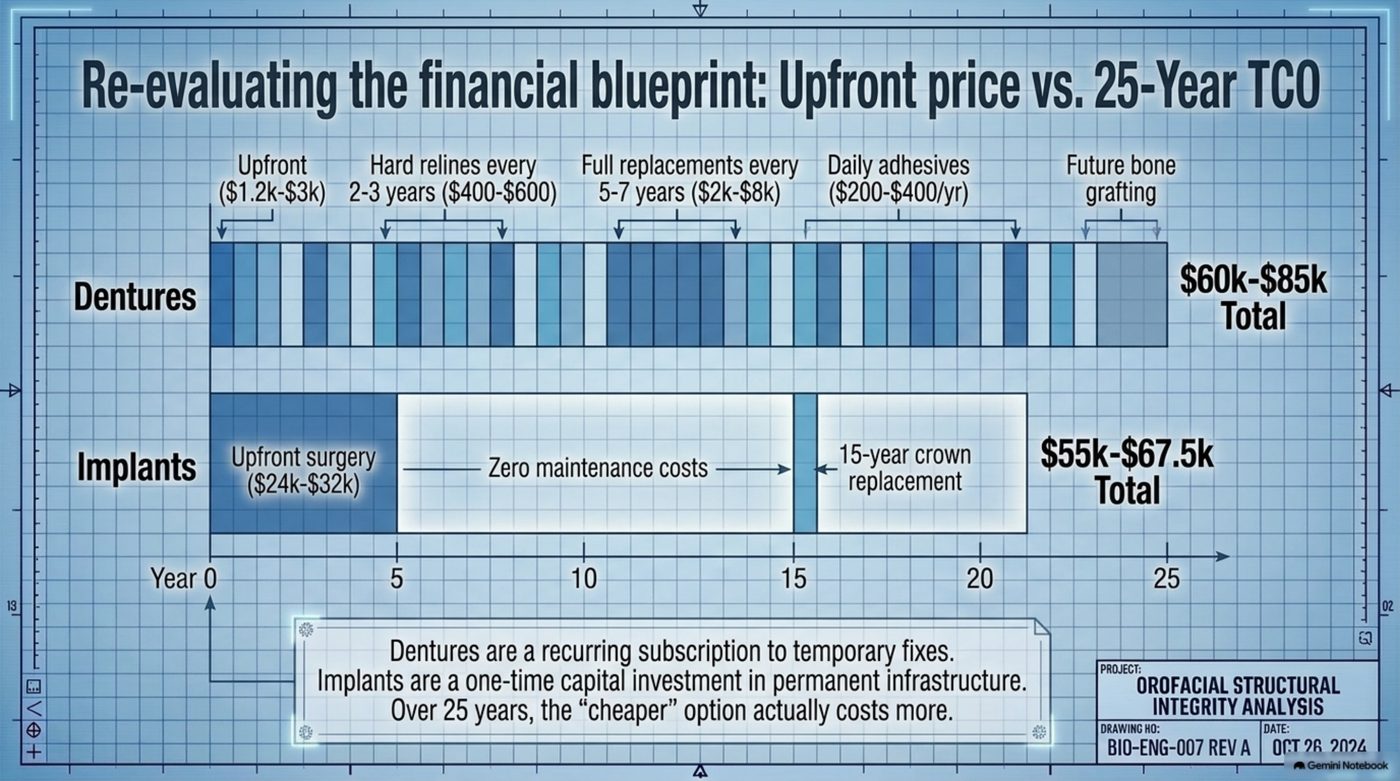
Denture advertising sells one number, and implant advertising sells a different, larger one. Slide 8 of the "Engineered for Life" deck (drawing BIO-ENG-007, rev A) does the honest thing and puts both numbers side by side across 25 years. The result inverts the sticker shock. The cheap option starts low and keeps charging, while the expensive option starts high and then mostly stops. By the end of the term the totals land in the same neighborhood, and one of them has bought you permanent infrastructure.
Two ways to read the same price
An upfront price and a cost of ownership answer different questions. The first asks what you pay to walk out the door with something. The second asks what you pay across the years you own it, including every reline, replacement, adhesive, and revision that the first number never mentioned. The deck calls these the upfront price and the 25-year total cost of ownership, and it builds the comparison from the line items rather than from the headline figure. Once you line the items up, the pattern stops being about money and starts being about what you are actually buying.
Dentures: a recurring subscription to temporary fixes
The denture column starts with an upfront cost of $1,200 to $3,000, which is genuinely low and genuinely why so many patients begin there. Then the recurring charges begin. Hard relines are needed every 2 to 3 years at $400 to $600 each, because the removable base sits on a jaw that keeps changing shape. Full replacements come every 5 to 7 years at $2,000 to $8,000 as the appliance wears and the fit drifts. Daily adhesives run $200 to $400 per year and never stop. On top of that, the deck notes future bone grafting, the structural consequence of an arch that is not loaded by tooth roots. These are not optional upgrades. They are the running cost of doing business with a removable device.
Implants: a one-time capital investment in permanent infrastructure
The implant column front-loads the pain. Upfront surgery runs $24,000 to $32,000, which is the number that stops most people, and it is worth being blunt about it. After that, the recurring line reads zero maintenance costs of that kind, because there are no relines, no adhesives, and no periodic full replacements driven by wear. The one scheduled intervention the deck lists is a 15-year crown replacement, a single event in a quarter century rather than a rhythm. That is what a capital investment in permanent infrastructure means in practice: you pay once for a structure, then maintain it lightly instead of replacing it repeatedly.
The 25-year timeline, year by year
Lay the two models on a timeline and the shape of the burden becomes obvious. At Year 0, dentures are far ahead on cost and implants are far behind. By Year 5, the denture patient has absorbed relines and is nearing the first full replacement, while the implant patient has paid once and is done spending. Year 10 brings another replacement cycle and the running total climbs steadily, while the implant line stays almost flat. Around Year 15 the implant patient meets the crown replacement, a single scheduled cost, while the denture patient settles into a third replacement. Year 20 shows the same divergence, and by Year 25 the denture total has stacked up repeatedly while the implant total has barely moved since surgery. The two curves cross, and the early advantage disappears.
Reading the totals side by side
| Cost line | Dentures | Implants |
|---|---|---|
| Upfront cost | $1,200 to $3,000 | $24,000 to $32,000 (surgery) |
| Hard relines | Every 2 to 3 years, $400 to $600 each | None |
| Full replacement | Every 5 to 7 years, $2,000 to $8,000 each | None |
| Daily adhesives | $200 to $400 per year | Zero maintenance costs of that kind |
| Future bone grafting | Yes | Not part of this model |
| Scheduled crown replacement | Not applicable | At 15 years |
| 25-year total | $60,000 to $85,000 | $55,000 to $67,500 |
The deck's totals settle the argument: $60,000 to $85,000 for the removable route and $55,000 to $67,500 for the implant route across the same 25 years. That is the reversal most patients never see, because they compare a $3,000 entry price against a $24,000 entry price and stop there. The higher upfront cost is not the expensive option. It is the option that finishes spending sooner, and it happens to finish lower. You can model your own version of this with our total cost of ownership calculator, which lets you put your own figures into the same 25-year frame.
Why the numbers land where they do
The gap narrows for a mechanical reason, not a marketing one. A removable appliance is loaded by soft tissue, so it moves, and movement means the fit changes, which means relines, which means replacement. An implant-supported arch is loaded by bone through integrated posts, so it is stable and does not need to be redone on a schedule. The deck captures the difference in one line: dentures are a recurring subscription to temporary fixes, and implants are a one-time capital investment in permanent infrastructure. Everything in the table is downstream of that sentence. If you want to understand what sits inside a price quote before you compare quotes, start with what your implant quote covers, and if you are weighing the fixed-arch path specifically, the All-on-4 buyer's blueprint walks through the same ownership logic for an all-on-4 approach.
Frequently asked questions
Are the implant totals really cheaper than dentures?
By the deck's numbers, yes, within the ranges given: $55,000 to $67,500 for implants against $60,000 to $85,000 for dentures over 25 years. The important word is "over." In the first years the denture route costs far less. The crossover happens later, and the implant total only wins because it stops growing. If your planning horizon is short, the arithmetic looks different, and that is a legitimate consideration.
Why does the implant column show no maintenance costs?
Because the recurring items that dominate the denture column do not exist in the same form. There are no hard relines and no daily adhesives, since the arch is fixed in place and held by integrated implants rather than by tissue contact and suction. The deck's phrase is zero maintenance costs of that kind, which is deliberately narrow. It is not a claim that implants need nothing; it is a claim that they do not need the specific recurring services a removable denture does.
What is the 15-year crown replacement?
It is the single scheduled intervention the deck assigns to the implant column, listed as a 15-year crown replacement. Instead of repeated full replacements, the implant model carries one planned event at the 15-year mark, which is why its 25-year total stays between $55,000 and $67,500. Treating it as one entry on a timeline rather than as an ongoing rhythm is the whole point of the comparison.
The practical lesson of slide 8 is that a price and a cost are not the same thing. The denture quote you see online is real, and so is the recurring bill behind it. The implant quote looks larger because it buys a different kind of asset, one that stops being a yearly expense. If you want to compare the two against your own situation, get matched with Cape Coral providers and ask each of them to walk you through the line items, not just the entry price.
This guide expands slide 08 of Engineered for Life: The Biomechanics and Economics of Dental Implants
For the complete slide-by-slide narrative, read the full deck walkthrough.