The Return on a Permanent Implant Investment: Structure, Money, and Life
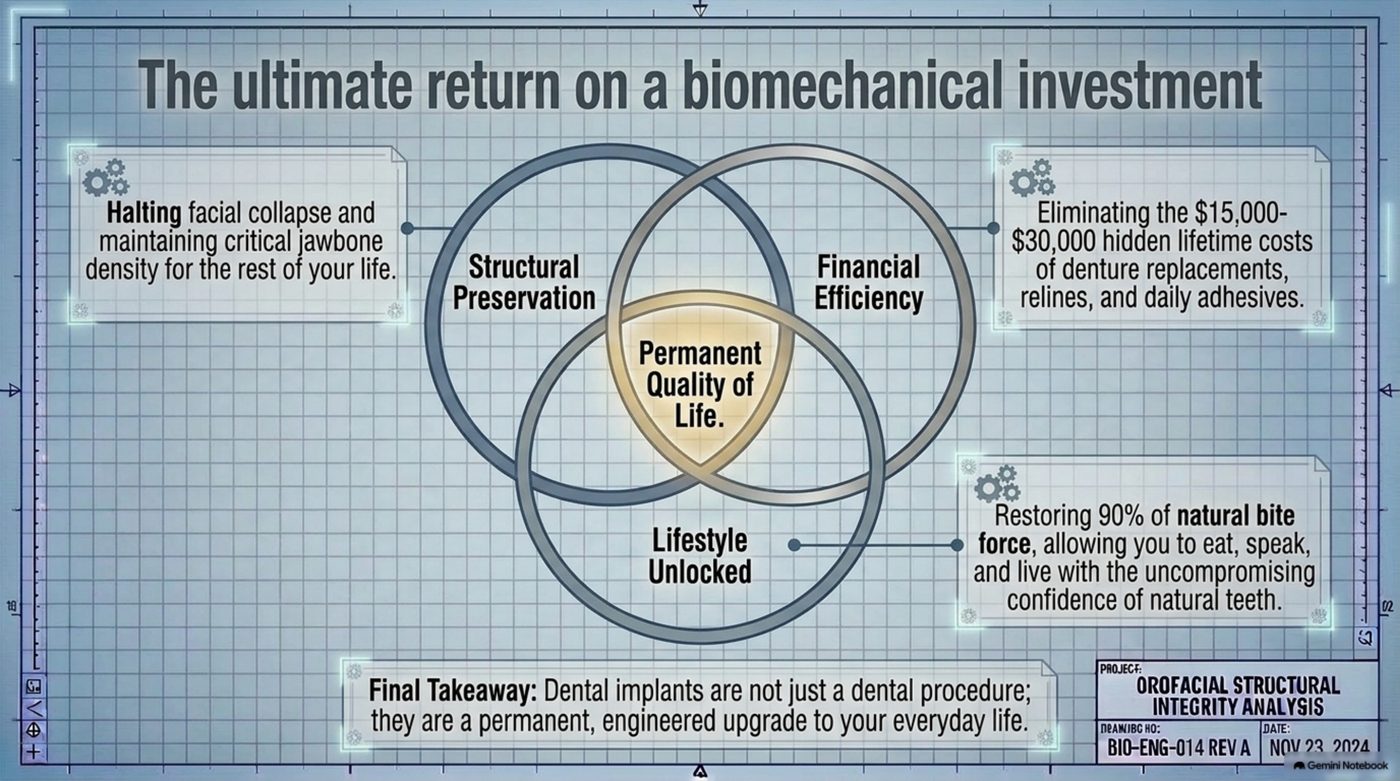
Every engineered structure is judged by what it returns across its service life, not by what it cost on day one. Drawing BIO-ENG-014, the closing sheet of the "Engineered for Life" evaluation, makes that case for dental implants in three parts: a return in structure, a return in money, and a return in daily life. Read together, they turn a dental bill into a capital decision.
Three returns on one engineered decision
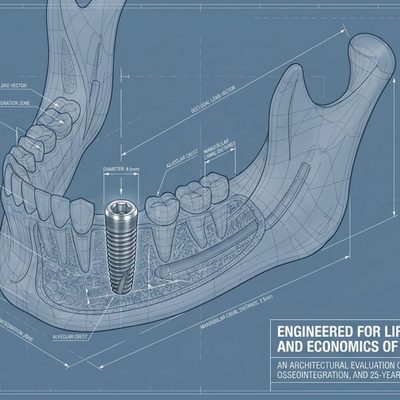
The earlier drawings in the deck size up missing teeth the way an engineer sizes up a failing foundation. Bone resorbs when there is no root to stimulate it, and dentures sit on top of the gums providing no structural load at all, so the collapse quietly continues underneath them. Against that background, the final drawing reframes the choice as an investment with a measurable return rather than a single expense to be minimized.
That reframing matters because the three returns arrive on different clocks. The structural return accrues silently across your whole life. The financial return shows up as costs you never have to pay. The lifestyle return is felt the first time you bite into something you had quietly given up. One decision, three ledgers, and a lifetime to collect on each of them.
Structural preservation: the return you cannot see
The first return is the hardest to photograph, which is exactly why it is easy to undervalue. Implants halt facial collapse and maintain critical jawbone density for the rest of your life. A titanium post transmits chewing load into the bone the way a natural root does, and bone that is loaded stays bone. The resorption spiral that follows tooth loss is interrupted at its source rather than covered over with a removable plate.
This is the difference between treating a symptom and fixing a structure. A denture can restore an outline of teeth, but it cannot restore the load path that keeps the jaw's architecture intact. If you want to see how quickly the alternative plays out, the timeline of jawbone atrophy and bone width traces the same decline the deck diagrams, and the full biomechanical blueprint follows the load paths that hold it back.
Financial efficiency: the $15,000–$30,000 you stop paying
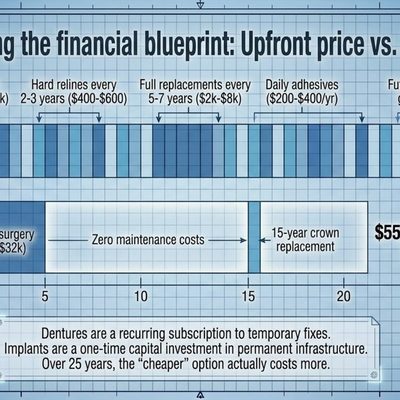
The second return is easier to put a number on. BIO-ENG-014 identifies $15,000–$30,000 in hidden lifetime costs attached to dentures: replacements, relines, and daily adhesives. None of those line items appears on the sticker price. They arrive in five-year installments, which is why denture care feels affordable in year one and expensive by year fifteen.
An implant removes that recurring stream entirely. You are not comparing a small denture bill to a larger implant fee, you are comparing a subscription to a one-time build. The 25-year total cost of ownership comparison lays the two curves side by side over the full span. When you want an answer for your own situation, the implant vs. bridge ROI tool lets you drop your own numbers into the same logic the drawing uses.
Quality of life: 90% of natural bite force
The third return is the one patients notice first. Implants restore 90% of natural bite force, which is the mechanical reason you can eat, speak, and live with the confidence of natural teeth. Chewing capacity is not a comfort feature. It decides which foods stay on your plate, how clearly you speak to a room, and how often you think about your mouth during an ordinary day.
Ninety percent is the figure that turns function back into instinct. Above that threshold, biting stops being a decision. You stop cutting food into timid pieces, stop skipping anything with a crust, and stop rehearsing conversations before a dinner out. The structure is carrying the load, so you are free to stop paying attention to it.
The three returns side by side
The drawing's whole argument fits in one comparison. Each return answers a different fear: losing your face, losing money on a loop, and losing the small freedoms of eating and speaking without giving them a thought.
| Return | What it preserves | The figure from BIO-ENG-014 |
|---|---|---|
| Structural preservation | Halts facial collapse and keeps critical jawbone density under load | Maintained for the rest of your life |
| Financial efficiency | Ends denture replacements, relines, and daily adhesives | $15,000–$30,000 in hidden lifetime costs eliminated |
| Quality of life | Restores chewing, speech, and everyday confidence | 90% of natural bite force recovered |
The final takeaway from BIO-ENG-014
The closing line of the deck is deliberately blunt: dental implants are not just a dental procedure, they are a permanent, engineered upgrade to your everyday life. That sentence is the whole series in miniature. Everything upstream, the load vectors, the thread tolerances, the fusion of bone to titanium, exists to make one downstream outcome true for you.
The word to hold onto is permanent. A denture is a consumable. An implant is infrastructure, built once and loaded for decades, and the returns it pays are the same ones an engineer would demand from any structure: it holds, it lasts, and it is worth the capital.
Turning the takeaway into a decision framework
If the deck is right, the question in front of you is not "what will this cost" but "which of the three returns matters most to me, and does my plan actually deliver it?" Use the framework the final drawing implies:
- Start with structure. If bone density is already compromised, the plan has to answer for that before anything else, which is where full mouth implant planning begins.
- Run the money honestly. Add five years of adhesives, one reline, and one replacement, then compare that total to a one-time build instead of comparing it to the smallest possible denture.
- Finish with life. List the foods and the conversations you currently avoid, and decide whether 90% of natural bite force is worth restoring.
Frequently asked questions
What does "return on a permanent implant investment" actually mean?
It means the implant is judged by what it pays back over time, not by its upfront price. BIO-ENG-014 breaks that return into three parts: structure that stays intact, denture costs you never pay again at $15,000–$30,000 across a lifetime, and 90% of natural bite force restored.
How long do the three returns actually last?
The drawing frames the structural return as lasting the rest of your life, and the financial return as permanent because the recurring denture costs simply stop. The lifestyle return lasts as long as the restoration is maintained, which is why routine hygiene and checkups still matter after the work is finished.
Is 90% of natural bite force really enough to eat normally?
It is the threshold where function goes back to being instinct. At 90% you can eat, speak, and live with the confidence of natural teeth, which is how the drawing states the third return. Most patients stop noticing their bite and start noticing their meals.
Three returns, one decision. If you are weighing a full-arch restoration in Cape Coral, the useful next step is not more research but a real comparison against your own numbers, and you can get matched with Cape Coral providers for a free, no-obligation quote that puts structure, money, and life side by side. Call (239) 341-0888 when you are ready to start.
This guide expands slide 15 of Engineered for Life: The Biomechanics and Economics of Dental Implants
For the complete slide-by-slide narrative, read the full deck walkthrough.