Phase Two: Osseointegration, Weeks 5 to 12 — and the Golden Rule
By week five the swelling is gone, the soreness has faded, and the implant feels like a permanent part of your mouth. Behind that calm, drawing BIO-ENG-011 shows a jawbone actively treating the titanium post as part of the natural skeleton. Phase two is the quiet, invisible half of the build, and it comes with one rule that matters more than any other.
Where phase two sits in the construction timeline
The deck tracks implant treatment as three phases. Phase one covers the critical first seven days of site management, when the job is rest, clot protection, and control of swelling. Phase three, running from roughly month three to month six, ends with final X-rays that verify fusion and the fitting of the permanent restoration.
Phase two is the span between them: weeks five through twelve, when the site looks healed but the structure is still forming. Your surgeon will usually check the implant during this window, and there is little to see on the surface. The work at this stage happens at a scale you cannot feel, at the boundary where living bone meets a metal post.
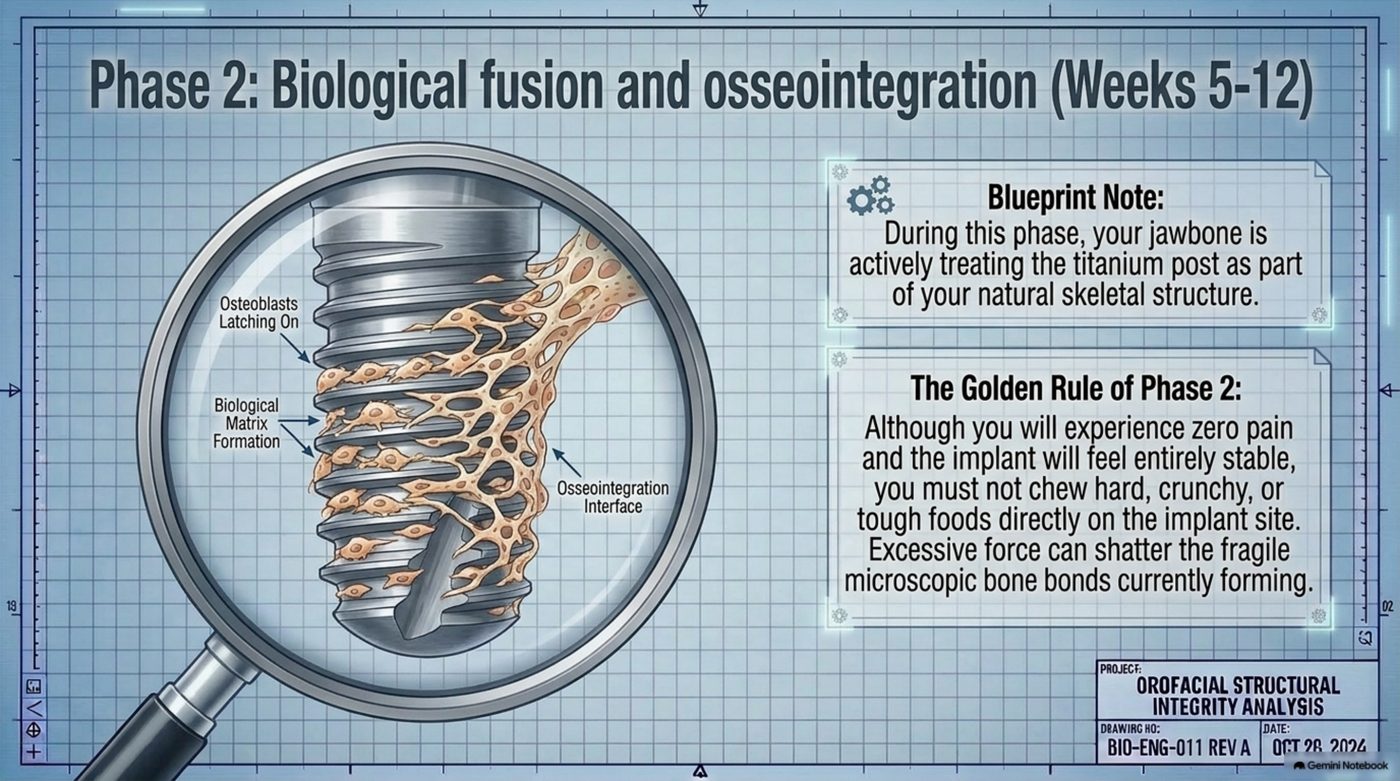
Osteoblasts latching on
The first stage of phase two is cellular. Osteoblasts, the cells that build bone, migrate to the titanium surface and attach to it. Titanium is not rejected here, because the body reads it as biocompatible rather than foreign, so the usual defensive wall never goes up. Instead, bone-forming cells settle onto the surface and begin the work that will eventually lock the post in place.
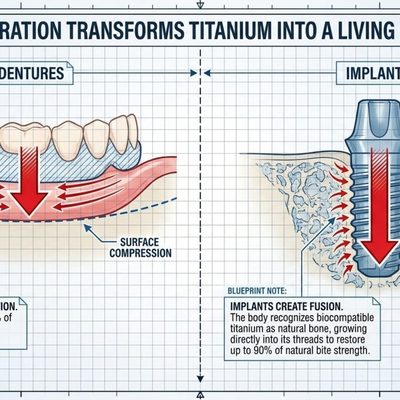
This is the stage that makes an implant different from every removable option. A denture rests on top of the gums and delivers its load to soft tissue. An implant invites bone to grow into it, which is why the deck describes implants as creating fusion rather than friction.
Biological matrix formation
Once the osteoblasts have attached, they begin laying down a biological matrix, the organic framework that mineralizes into new bone. Picture a scaffold being erected against the threads of the post, filling the microscopic gaps between metal and bone with material that will harden over the following weeks.
Nothing about this stage announces itself. There is no swelling to watch and no pain to interpret, which is precisely why the deck spends a whole drawing on it. Patients judge healing by how they feel, but the matrix does not care how you feel. It forms at its own pace as long as nothing mechanical disrupts it. The wider distinction between the two ways an implant can hold is the subject of the article on fusion versus friction.
The osseointegration interface
The third stage is the interface itself: the zone where the matrix has matured and the bone is now in direct contact with the titanium. This is what clinicians mean by osseointegration, and it is the structural reason an implant can later carry close to the full load of a natural tooth. The deck's drawing frames it as the point where the post stops being hardware and starts being foundation.
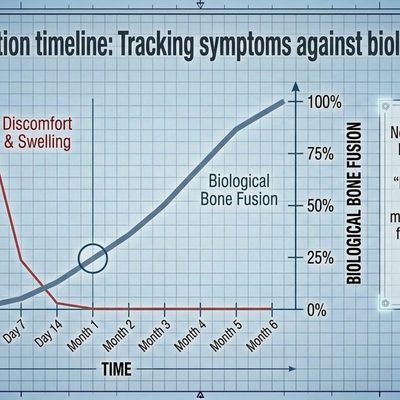
The interface does not form all at once. It develops progressively through weeks five to twelve and continues well past them, which is why the mouth can feel finished long before the structure is. A useful way to hold this is to separate symptom recovery from structural recovery, exactly as laid out in the symptoms versus bone fusion timeline.
The golden rule of phase two
Here is the part that catches patients out. During these weeks you will experience zero pain, and the implant will feel entirely stable. It is easy to conclude that it is ready for anything. It is not. The bone bonds forming at the interface are microscopic and fragile, and they can be shattered by load applied too early.
So the rule is absolute: do not chew hard, crunchy, or tough foods directly on the implant site. That means no biting down on ice, nuts, hard candy, crusty bread, or dense meat over the implant. Chew on the opposite side, cut food into smaller pieces, and treat the area as a construction zone that is still curing. This carries forward the same principle that governs the first week, where the day-by-day site management protocol rules out straws and vigorous rinsing into a longer, quieter window.
Living through the fusion window
Phase two is mostly a matter of patience with a handful of practical habits. Soft and semi-soft foods keep the site unloaded. Gentle hygiene keeps bacteria away from the healing interface, since infection is the one thing that can interrupt fusion from the outside. And your scheduled check-ins give the provider a chance to confirm the implant is behaving.
| Stage of phase two | What the bone is doing | What you will notice | Your rule for the stage |
|---|---|---|---|
| Osteoblasts latching on | Bone-forming cells attach to the biocompatible titanium surface | Nothing painful; the site looks healed | No hard, crunchy, or tough foods on the implant |
| Biological matrix formation | A mineralizing matrix fills the space against the threads | Zero pain; the implant feels entirely stable | Keep chewing on the opposite side |
| Osseointegration interface | Bone and titanium come into direct contact | No symptoms at all | Load the implant only when cleared |
Because symptoms are absent, a calendar is more useful than a feeling. A healing timeline calculator such as the healing progress calculator gives you a rough idea of where you are between day one and full fusion, which is a steadier guide than judging by comfort alone.
What phase two does not include
This window ends when the provider is satisfied that integration has gone far enough, and it hands off to the phase three milestones: final X-rays confirming complete fusion, the abutment that bridges the gap through the gumline, and eventually the permanent restoration and a diet with no restrictions. Until then, the temporary teeth are exactly that, temporary, and they are not an invitation to test the bond.
The reassuring part is that phase two asks almost nothing of you except restraint. The body does the building. Your job is to not interrupt it, which is a far easier assignment than the careful routine of the first week. If you want to compare the whole arc of healing against what you actually experience, the month-by-month recovery timeline is the place to start.
Frequently asked questions
Why does the implant feel fine if the bone is still forming?
Because discomfort follows the surgical trauma, and that resolves in the first week or two, while the biological interface keeps developing through weeks five to twelve and beyond. Feeling stable reflects the mechanical grip, not finished fusion.
Can I chew normally if I feel no pain at all?
Not on the implant site. Drawing BIO-ENG-011 is explicit that zero pain does not mean the bonds are strong, and excessive force can shatter the fragile microscopic bonds that are forming. Chew elsewhere until you are cleared.
How long does phase two last?
The deck places it across weeks five to twelve, with fusion continuing to develop past that span. Your surgeon will confirm progress at check-ins and decide when the site can take normal load.
Phase two rewards a patient who can accept that feeling healed and being finished are two different things. Follow the golden rule, keep the load off the site, and the fusion window closes on schedule. To compare local practices and be matched with one that fits your case, get matched with Cape Coral providers free of charge and with no obligation.
This guide expands slide 12 of Engineered for Life: The Biomechanics and Economics of Dental Implants
For the complete slide-by-slide narrative, read the full deck walkthrough.