Why You Feel Healed at Week Two: Symptoms vs. Bone Fusion
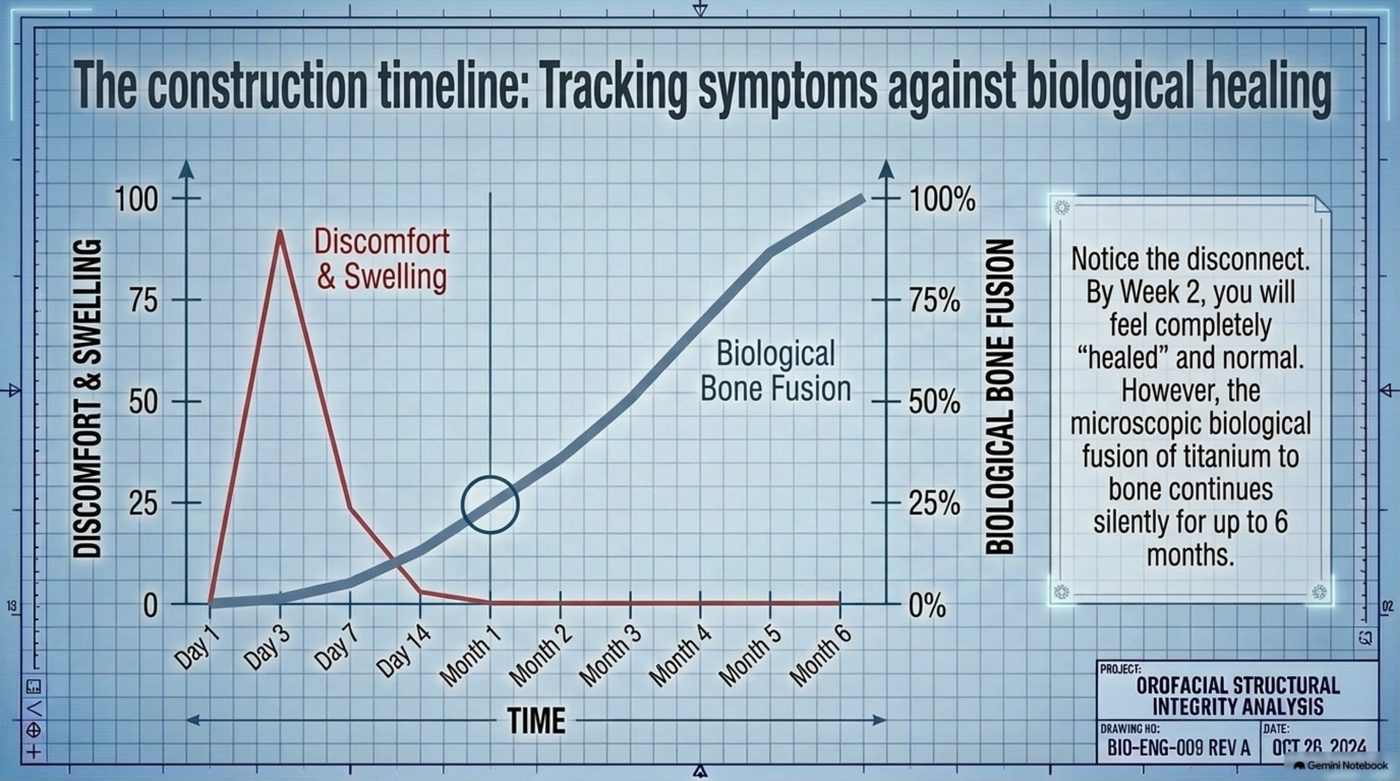
Slide 10 puts two curves on one chart: discomfort and swelling, and biological bone fusion. The symptoms peak early and fall away. Fusion does not. By the time you feel completely healed and normal at week two, the microscopic bond between titanium and bone is only about half built, and it keeps growing in silence for up to six months.
Two curves, one chart, one wrong conclusion
Track the two lines separately and both make sense. Track them together and they invite a false conclusion. Discomfort and swelling spike fast after surgery, then drop off. Biological bone fusion rises slowly and never spikes at all. The gap between the two curves opens up right around week two, and it stays open for months afterward.
That gap is the point of the drawing. Notice the disconnect, the slide says, because your body will send you a clear signal that the work is over long before the work is actually over. Patients who trust the symptom curve and resume hard chewing at week three are loading a structure that is only half fused.
What the 0 to 100 scale actually measures
The chart runs both quantities on the same 0 to 100 scale, from 0% to 100%. The discomfort and swelling line tracks how much you feel. The biological bone fusion line tracks how much of the microscopic union between the titanium surface and living bone has been achieved.
Those are two different kinds of measurement sharing one grid. Symptom intensity is about sensation and inflammation, and it can collapse quickly once the tissue calms down. Fusion is about biology and structure, and it can only build at the speed bone builds. Putting them on one axis makes the mismatch visible, which is exactly why the slide does it.
Day 1 to Day 14: the symptom curve falls fast
The timeline runs Day 1, Day 3, Day 7, Day 14, then Month 1 through Month 6. The symptom curve does most of its dramatic work inside that first two weeks. Discomfort and swelling are highest early, then drop as inflammation resolves and the surgical site settles.
By Day 14, the visible story is largely over. The swelling that defined the first week is gone, the site looks calm, and the sensation that something was done to your mouth has faded. It feels like a completed project. It is not, and the day-by-day recovery timeline makes the same point: the quiet weeks are when the real structure is being built.
Why fusion is only half done at week two
Here is the number that matters most on slide 10. Biological bone fusion reaches about 50% by Week 2. That is the same week your symptoms disappear. The microscopic fusion of titanium to bone is, in other words, only halfway built at exactly the moment you feel finished.
The remaining half is not a repeat of the first. It is the slower, denser work of maturing the bond until the implant can carry real load without micromovement. That process continues silently, in the slide's own description, for up to 6 months. There is no sensation attached to it, which is precisely why it is so easy to forget.
Feeling fine is not the same as being finished
Sensation is a poor measure of structural completion. Your jaw does not send pain signals while bone is quietly remodelling around a titanium surface, so the absence of symptoms carries very little information about how far along the fusion actually is.
This is the same principle behind the difference between primary stability, the mechanical grip from the moment of placement, and secondary stability, the biological grip that grows in afterward. Primary stability can feel impressive right away and still not be ready for load. The fusion versus friction explanation unpacks that distinction, and the phase two osseointegration window covers the weeks when the biological grip takes over.
What the disconnect means for diet and load
If the symptom curve is not a green light, what is? The honest answer is the fusion curve, and it moves on its own schedule. That has two practical consequences for the months after week two.
Diet stays conservative past the point of comfort. Firm and normal foods can return as healing progresses, but hard, brittle, or very chewy items should not be aimed directly at an implant site while fusion is still climbing toward completion. The pull to test the new teeth with something crunchy at week three is the exact behaviour the chart warns against.
Load is managed, not avoided. Bone responds to controlled forces and resents uncontrolled ones. Chewing on the opposite side early, keeping hard objects off the site, and following the surgeon's progression schedule all protect the half-built bond during the weeks it is most vulnerable to micromovement. If you want a sense of where you sit on that curve, the healing timeline calculator turns your dates into a phase-by-phase view, and the implant recovery and aftercare pages cover what to expect at each stage.
The timeline at a glance
The table below reproduces the slide's two curves as a reference sheet, so you can see where symptoms and fusion sit at each marker.
| Timeline marker | Discomfort and swelling | Biological bone fusion | What it implies |
|---|---|---|---|
| Day 1 | Highest on the 0 to 100 scale | Barely begun | Rest, cold, soft food only |
| Day 3 | Still near peak | Earliest microscopic contact | Keep the site quiet and unloaded |
| Day 7 | Falling | Low but climbing | Soft diet, chew on the opposite side |
| Day 14 | Nearly gone | About 50% | Do not mistake comfort for completion |
| Month 1 | Minimal | Climbing past half | Firmer foods, still no hard load |
| Month 3 | Effectively none | High | Follow the surgeon's load schedule |
| Month 6 | None | Approaching completion | Fusion continues up to this point |
Read the table top to bottom and the message is the same as the chart: the column you can feel empties out long before the column that matters fills up. Trust the curve that has no sensation attached to it, because that is the one holding your new teeth in place.
Frequently asked questions
If I feel no pain at week two, is the implant integrated?
Not yet. The chart puts biological bone fusion at about 50% by Week 2, which is the same point at which discomfort and swelling are nearly gone. Feeling normal is a real milestone, but it is about sensation, not structural completion.
How long until fusion is genuinely finished?
Up to 6 months. The slide describes the microscopic fusion of titanium to bone as continuing silently for that long, well past the point where symptoms vanish and the site looks healed.
Can I eat normally once I feel fine?
Comfort is not the deciding factor. Firm foods can return as healing progresses, but hard, brittle, or very chewy items should not be aimed directly at the implant site while fusion is still climbing, because the half-built bond is vulnerable to micromovement.
The two curves on slide 10 are a lesson in trusting biology over sensation. Your mouth will tell you the site is comfortable long before the bone tells you the structure is ready, and the gap between those two messages is where good outcomes are protected or lost. If you want help reading your own timeline, get matched with Cape Coral providers who can map your schedule, your diet, and your load limits against the real fusion curve. It is free and there is no obligation.
This guide expands slide 10 of Engineered for Life: The Biomechanics and Economics of Dental Implants
For the complete slide-by-slide narrative, read the full deck walkthrough.