The Critical First Seven Days: A Day-by-Day Site Management Protocol
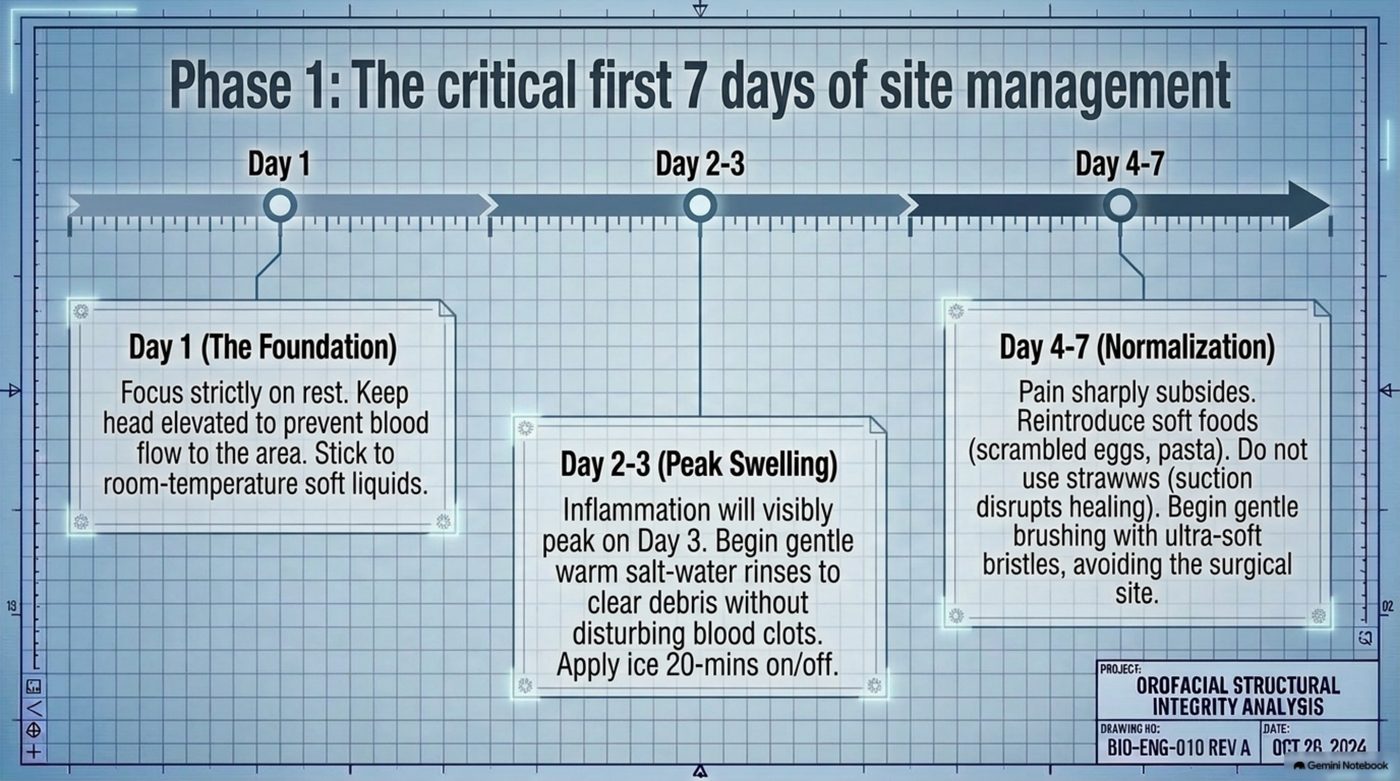
Your implant is placed, the anesthetic is fading, and the real work of week one has just started. Drawing BIO-ENG-010 splits those seven days into three distinct phases: the foundation, the peak of inflammation, and the return to normal. Each phase asks something different of you, and getting the sequence right protects the blood clot and the microscopic bond that everything else depends on.
Why week one decides the rest of the build
An implant is held in place twice: first mechanically, by the friction of the post inside the prepared bone, and later biologically, when bone grows into the titanium surface. Week one is when the mechanical grip has to survive on its own. A blood clot forms around the site and acts as the scaffold that bone-forming cells will eventually build on. Disturb that clot, or push too much blood into the area, and the timeline does not fail outright, it just gets harder.
That is why the deck treats the first seven days as a protocol rather than a suggestion. The instructions are not about comfort, although comfort improves as a side effect. They are about protecting a structure that is only a few hours old. Patients who plan the week in advance, with food bought and time cleared, tend to move through it with far less guesswork. To see where these seven days sit inside the full arc of healing, the month-by-month recovery timeline places them against the months that follow.
Day 1: the foundation
Day one has one job: rest. The instruction is strict and simple. Keep your head raised above the level of your heart to limit blood flow to the surgical area, because extra pressure there means more throbbing, more oozing, and a clot under greater strain. Prop yourself up with pillows rather than lying flat, and take the day off entirely.
Eating on day one means room-temperature soft liquids only. Nothing hot, because heat widens blood vessels exactly where you do not want extra flow. Nothing that requires chewing near the site. Cooled soup, a smoothie eaten with a spoon, yogurt, and water all work. This is also the day to start any prescribed medication before the anesthetic fully wears off, so the first wave of soreness meets an already-established baseline.
Days 2 and 3: when swelling peaks
Inflammation will visibly peak on day three. This is the loudest the site will look and feel, and it is expected rather than a sign that something has gone wrong. Bruising may appear on the jaw or cheek, the area will feel tight, and you may notice your speech adjusting to the new hardware.
Two actions belong in this window. The first is ice, applied in cycles of twenty minutes on and twenty minutes off, which limits how much fluid collects in the tissue. The second is a gentle warm salt-water rinse, started now because it clears food debris and bacteria without the force that would disturb the clot. Gentle is the operative word: let the liquid move over the site rather than swishing it hard.
Days 4 through 7: normalization
Pain sharply subsides in the back half of the week. Swelling drops, the gum settles, and the site stops demanding your full attention. Soft foods come back onto the menu, and scrambled eggs and pasta are good first choices because they need almost no chewing and leave little residue behind.
Brushing restarts in stages. Use an ultra-soft bristle brush on the rest of your mouth and keep it away from the surgical site itself for now. One rule carries more weight than it seems to deserve: do not use a straw. Suction pulls at the clot and disrupts healing, which is why every drink this week should be taken from a cup or a spoon.
The protocol at a glance
The table below condenses the deck's three day-blocks into a single reference you can keep on the fridge or bookmark on your phone.
| Window | What is happening | What you do | What you avoid |
|---|---|---|---|
| Day 1 (The Foundation) | Primary stability holds the post while the blood clot forms | Rest with your head raised; room-temperature soft liquids | Heat, chewing, exertion, lying flat |
| Day 2–3 (Peak Swelling) | Inflammation visibly peaks on day 3 | Ice 20 minutes on and off; gentle warm salt-water rinses | Vigorous rinsing that disturbs the clot |
| Day 4–7 (Normalization) | Pain sharply subsides and the gum settles | Reintroduce soft foods; brush with ultra-soft bristles | Straws, and brushing over the surgical site |
Two rules that are easy to break
Most first-week setbacks are not dramatic. They come from small conveniences. The straw is the classic example: a smoothie through a straw feels easier than a spoon, but the suction is a mechanical pull on a clot that has not finished organizing. The second is over-rinsing. Salt water helps when it is allowed to flow gently and does harm when it is swished with force.
Brushing is the third. An ultra-soft brush on the surrounding teeth keeps the mouth clean without pressing on the site, and the surgical area itself is left alone until your provider says otherwise. These details matter more in week one than at any later point, because everything after this window is built on what the clot and the fresh bone interface look like when the week ends.
What week one is really protecting
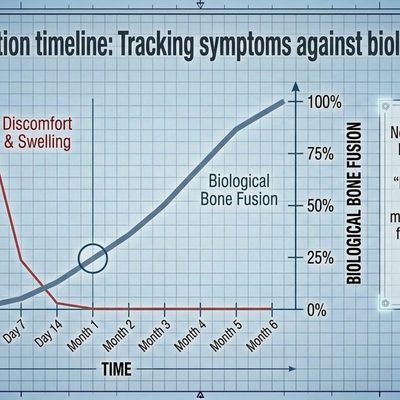
By day seven the visible crisis is over. Swelling has retreated, discomfort has dropped, and the implant feels surprisingly solid. It is tempting to treat that as the finish line. It is not. The mechanical grip you can feel is holding the post in place while the biological work has barely begun, and the fusion of titanium to bone continues silently for months.
That is the disconnect the deck highlights: symptom recovery and structural recovery run on different clocks. Week one sets the conditions for the fusion window that follows, which is covered in detail in the article on osseointegration in weeks five to twelve. If you are planning an All-on-4 case in particular, a printable All-on-4 recovery checklist keeps the daily steps in one place, and Cape Coral patients can see the full scope of aftercare on the implant recovery and aftercare page.
Frequently asked questions
Is it normal for swelling to get worse on day three?
Yes. Drawing BIO-ENG-010 places peak inflammation on day three by design, which is why the site often looks more dramatic on the third day than it did on the first. Swelling that then begins to subside is following the expected curve.
When can I start using a straw again?
The deck's instruction is to avoid straws through the first week, since suction disrupts healing. Most providers clear straws once the site has settled, and your own surgeon's guidance overrides any general timeline.
Should I brush my teeth during the first seven days?
Yes, but gently, and with an ultra-soft bristle brush. Clean the rest of your mouth as usual and keep the brush away from the surgical site itself, letting the salt-water rinse do the work around the implant.
Seven days of small discipline is what buys the calm months that follow. The steps are few, the reasoning is mechanical, and none of it is hard once the sequence is clear. To compare Cape Coral practices and be matched with one that fits your case, get matched with Cape Coral providers free of charge and with no obligation, or call (239) 341-0888 once to talk it through.
This guide expands slide 11 of Engineered for Life: The Biomechanics and Economics of Dental Implants
For the complete slide-by-slide narrative, read the full deck walkthrough.