The Engineering Case for Permanent Tooth Replacement
Most people file a missing tooth under "cosmetic" and then spend years managing the consequences. The deck "Engineered for Life: The Biomechanics and Economics of Dental Implants" opens on a different premise: losing a tooth is a structural failure inside a load-bearing system, and replacing it is an engineering decision that can be compared, measured, and priced.
A Missing Tooth Is a Structural Problem First
Look at a dental x-ray the way a structural engineer looks at a building frame and the picture changes. A tooth is not a decorative plug resting on the gum; it is the visible end of a root that drives chewing force down into the jawbone, and bone answers that force by staying dense. Remove the root and you remove the load path, not just the enamel.
The force that tooth once carried redistributes onto its neighbors, while the bone beneath the empty socket loses its usual stimulus and begins to recede. The gum line follows, teeth near the gap lean into it, and an arrangement that once shared load evenly starts working around a hole. Cosmetic describes what a mirror shows. Structural describes whether a repair still holds in twenty-five years.
Reading the Cover Slide Like a Drawing Set
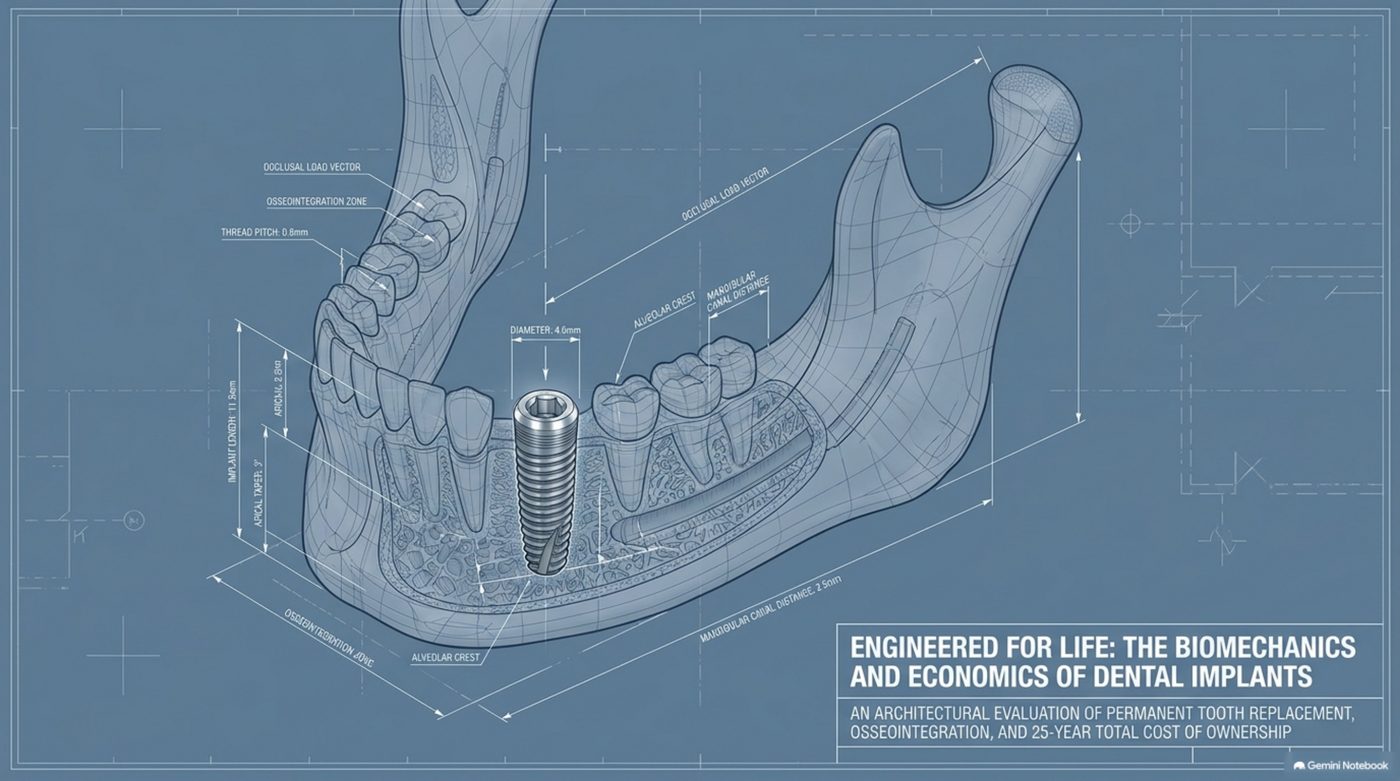
The first slide is not a photograph of a smile. It is an annotated cross-section: one implant drawn to scale, with the dimensions an engineer would want before signing off on the design. The cutting thread is called out at a pitch of 0.8mm, and the implant body is specified at a diameter of 4.6mm. Around it sits the osseointegration zone, the band of bone expected to close in and hold the titanium.
Below that, the drawing traces the alveolar crest, the ridge a denture would simply rest on, and continues into the apical taper, the narrowing shape where the implant seats at its tip. A mandibular canal is drawn in and dimensioned, so the clearance between that nerve canal and the implant is treated as a hard limit rather than an approximation. Across the top runs the occlusal load vector, the arrow describing the direction chewing force travels under load. The page carries a BIO-ENG-001 series drawing number, a revision letter, and a date, the same annotation standard the other slides use.
What the Deck Actually Evaluates
The subtitle names two axes, and the deck stays on them. The first is biomechanics: how load enters the implant, how bone fuses to it, and which tolerances decide whether that union lasts. The second is economics: not the sticker price of surgery, but the twenty-five year total cost of ownership, the figure that includes everything replaced, relined, and repaired along the way.
Holding both together is the point. An option that looks cheap in year one can be the expensive one by year fifteen, and an option that looks expensive up front is only a bad deal if the structure fails early. Permanent tooth replacement is evaluated here as infrastructure, and infrastructure is judged over its service life.
The Biomechanical Axis: Why Fusion Beats Friction
A rest that presses on soft tissue is held by friction, and friction is a maintenance contract. A rest that bone grows into is held by fusion, and fusion is a structure. That is the distinction the cover is making when it marks an osseointegration zone: the design assumes living bone will grow into the thread pattern and lock the implant in as part of the skeleton.
The 0.8mm thread pitch and the 4.6mm body diameter are not marketing dimensions. They describe how tightly load spreads across the bone surface, so that the occlusal load vector travels down the implant and into dense bone instead of concentrating at the gum line.
The Economic Axis: Twenty-Five Years Is the Real Price Tag
Dental work is usually priced like a purchase, but it behaves like ownership. A removable appliance is replaced, relined, and re-fitted on a schedule, and every one of those events carries a cost and a small loss of comfort. A permanent restoration is closer to a capital project: a larger sum at the start, then decades of routine maintenance.
The deck insists on twenty-five years because that is the span over which the two cost curves cross. Over one year, the removable option wins on price almost every time. Over twenty-five, the comparison tends to flip, and it flips harder once you count the second and third round of replacements the first round guarantees. If you want to run that math on your own situation, the implant survival simulator lets you vary the horizon and watch where the crossover lands.
The Blueprint Vocabulary, Translated
The cover uses drawing-room language for parts usually described in softer terms. Here is the translation, and why each annotation matters to an outcome you will feel.
| Drawing annotation | What it specifies | Why it matters |
|---|---|---|
| Occlusal load vector | Direction chewing force travels | Decides which bone carries the load |
| Thread pitch 0.8mm | Spacing of the cutting threads | Sets how load spreads into bone |
| Implant diameter 4.6mm | Width of the implant body | Sets surface area and strength |
| Osseointegration zone | Region bone grows into | This union is what makes it permanent |
| Alveolar crest | Bony ridge supporting the teeth | The ridge a denture rests on and erodes |
| Apical taper | Narrowing shape at the implant tip | Helps the implant seat without overloading |
| Mandibular canal distance | Clearance to the nerve canal | A hard limit on implant length and angle |
How to Use This Analysis Before You Commit
Read the deck as a due-diligence file rather than a brochure. Start with the structural question: is the bone at each site thick enough to accept an implant, and if not, what is the plan to rebuild it. Then the economic question: what the quoted price includes, what happens when something needs replacing, and how long the restoration should serve. Keep comfort third, because a solution that fails structurally takes your comfort with it.
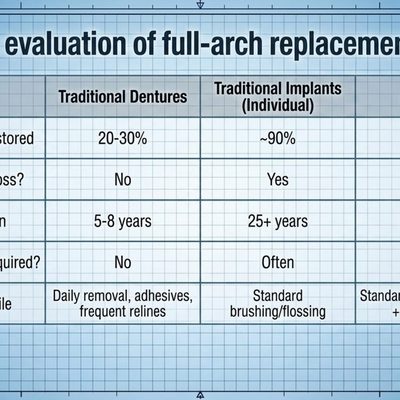
The full deck PDF carries that framing across all fifteen slides, and the slide-by-slide walkthrough unpacks each page in prose. If you would rather see the decision distilled into one view first, the full-arch options comparison matrix lays the alternatives side by side on the same axes this deck uses.
Frequently asked questions
Is a missing tooth really a structural problem?
Yes, in the sense that matters to your jaw. Once a root is gone, the bone around it loses the stimulus that kept it dense, and your bite forces redistribute onto the remaining teeth and the ridge. That is a change in how a system carries load, not merely a change in appearance.
Why does the deck use twenty-five years as its cost horizon?
Because it is long enough for the two cost curves to cross. A removable appliance is repurchased on a schedule, so its expense repeats, while a permanent restoration behaves more like a one-time capital cost with routine maintenance. Over a single year the cheaper option is obvious; over twenty-five, the ranking can reverse.
Do I need to understand the drawing dimensions to decide anything?
Not in detail, but they show the plan was engineered rather than improvised: when a plan specifies thread pitch, implant diameter, and clearance to the mandibular canal, the site was measured, the bone assessed, and the implant chosen to fit it.
The cover slide earns its place as page one because it changes the question. Instead of asking which option looks better, it asks which option still works in twenty-five years, and it answers with a load vector, a thread pitch, and a cost curve rather than a promise. When you are ready to compare plans or quotes, you can get matched with Cape Coral providers at no cost and with no obligation.
This guide expands slide 01 of Engineered for Life: The Biomechanics and Economics of Dental Implants
For the complete slide-by-slide narrative, read the full deck walkthrough.