Why All-on-4 Posts Are Tilted: The 45-Degree Engineering Trick
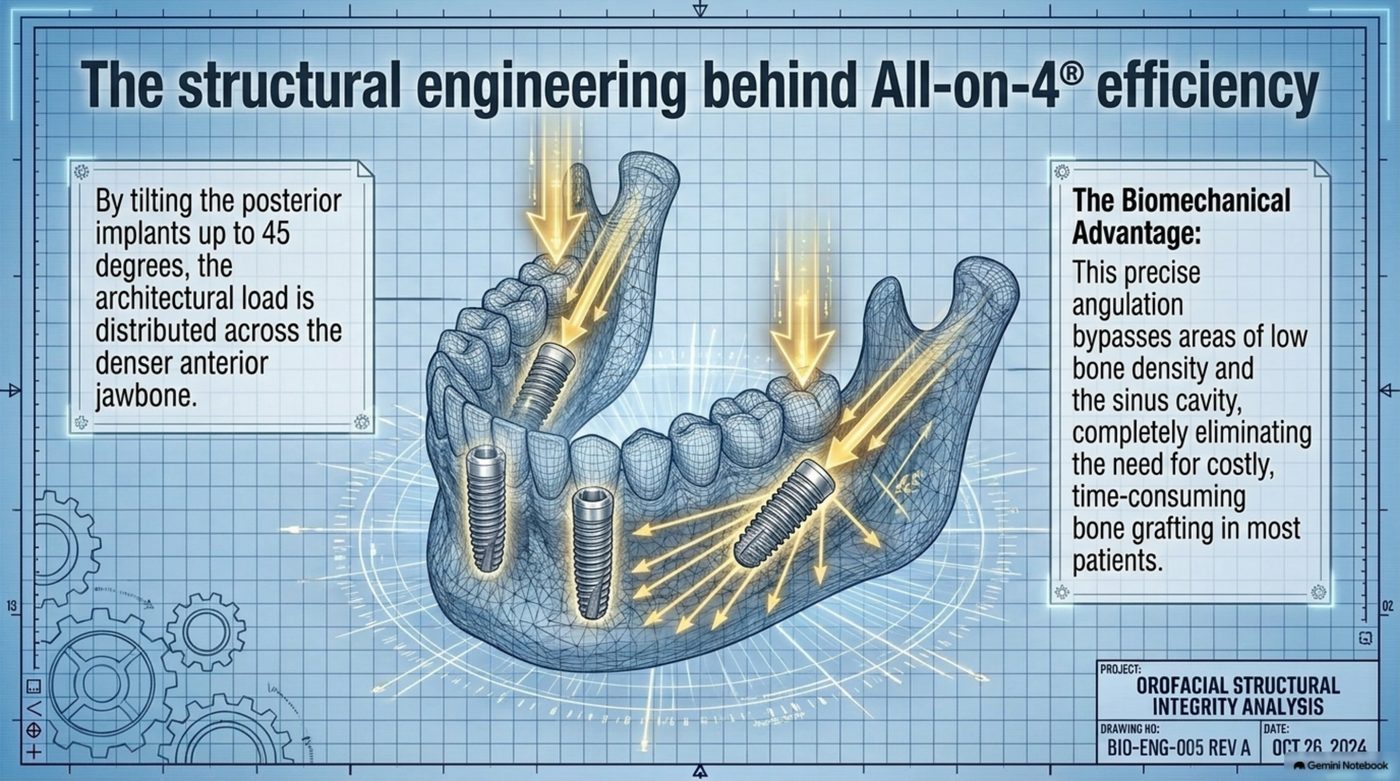
Every All-on-4 case begins with the same problem: how do you anchor a full arch in a jaw that no longer has usable bone where teeth used to sit? Drawing BIO-ENG-005 (revised Oct 26, 2024) refuses the premise, tilting the posterior implants up to 45 degrees so load is redistributed across the denser anterior jawbone.
What "Tilted" Actually Means
In a conventional implant the post goes in straight down, following the direction the original root once took. An All-on-4 arch angles its rear posts, in some cases up to 45 degrees, so they enter the jaw at an angle rather than perpendicular to the chewing surface. The prosthetic is unchanged; the direction of force is not.
That is not cosmetic, and it separates into the two effects the drawing describes. The first is redistribution, sending load into the denser anterior jawbone instead of the thin posterior region. The second is avoidance, routing the post around anatomy that would otherwise require a graft. Both halves matter for cost and timeline.
Load Distribution: Sending Force Where the Bone Is
Under normal chewing the heaviest forces arrive at the back of the mouth, and a conventional layout delivers them straight into the posterior jaw, the region that thins out first once teeth are gone. A tilted post changes the geometry: load is distributed across the denser anterior jawbone instead of concentrated where the bone is weakest.
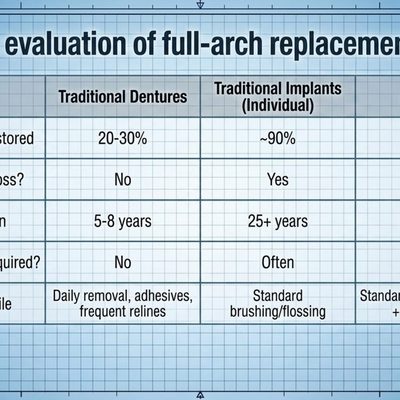
This is load path engineering more than hardware. Four posts positioned and angled as one structural system spread force differently from four posts each standing alone over their own patch of bone. The arch does not need more implants to be strong; it needs the ones it has aimed at better material, which is how the system holds roughly 90% of natural bite strength restored.
Why the Anterior Jawbone Is Denser
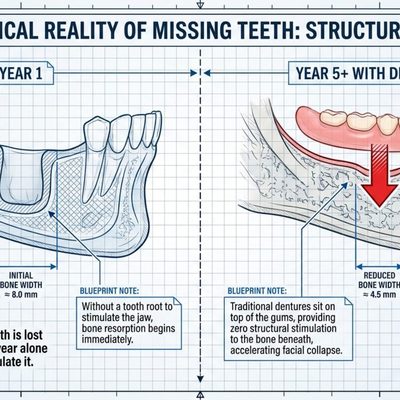
Bone is a use-it-or-lose-it material: it thickens where it is loaded and thins where it is not, which is why a jaw that has spent years without tooth roots loses volume in the regions that once did the chewing. The front holds up better because it sits under the incisors and canines, the teeth most people lead with, and further from the voids and sinuses that interrupt the posterior jaw.
The anterior jaw is therefore the part of the foundation still structurally useful in a patient who has been told there is not enough bone. Tilting the posterior posts toward it turns that surviving density into the anchor for the whole arch.
Bypassing the Sinus Cavity and Low-Density Zones
The upper jaw brings a constraint the lower jaw does not have: the sinus cavity. An upright post placed far enough back may need to cross territory close to the sinus, which is where a sinus lift or bone graft enters the plan, along with its own healing stage before implant work can begin.
The angled path is routed to avoid that. The posterior tilt lets the post reach healthy bone while steering clear of low-density zones and the sinus cavity, which is why the drawing concludes that this precise angulation removes the need for costly, time-consuming bone grafting in most patients. The word is most, not all, and the exceptions are real enough to plan for.
| Design Question | Upright Posterior Post | Tilted All-on-4 Post |
|---|---|---|
| Angle of placement | Straight down, along the old root line | Angled up to 45 degrees at the posterior sites |
| Where the load lands | Straight into the posterior jaw, where bone thins first | Distributed across the denser anterior jawbone |
| Low-density bone | In the post's path; often built up | Bypassed by the angulation |
| Sinus cavity | A possible obstacle requiring avoidance work | Routed around by the tilted path |
| Bone grafting | Commonly required before placement | Removed for most patients by the design |
What This Changes About Cost
Bone grafting is one of the line items that turns a clean estimate into a surprise. The drawing calls it costly and time-consuming: it is a second surgical procedure with its own materials and healing window that must finish before implants can be placed. Removing that step for most patients removes a cost and a stage at once.
That is the economic version of the engineering claim, and it is why angulation shows up in price conversations at all. Fewer procedures, fewer healing cycles and less added material act on the same bill. If grafting is necessary in your case, our comparison of the short implant versus sinus lift routes explains each path.
What This Changes About Timeline
Time is the quieter saving. A graft has to mature before it can hold an implant, which puts a waiting period in front of everything else. The tilted approach places implants during the primary surgery, so the case moves straight into the fusion phase instead of pausing while the foundation is rebuilt.
This is harder to value than money, but the timeline is where the savings compound. A shorter front end means treatment finishes sooner and less time is spent in a temporary prosthesis. The osseointegration article covers what happens once the angled posts are seated and bone begins closing around them.
When Grafting Is Still the Right Answer
Angulation solves a geometry problem; it does not replace grafting altogether. If the anterior jaw is also compromised, the tilted path has no denser material to lean on, and a graft remains correct. That is why the drawing says most patients rather than every patient. In those cases the plan looks more like a conventional full-arch case, and bone grafting for implants becomes the first step.
Hold on to the honest version: the tilt reduces how often grafting is needed and does not eliminate the possibility. That distinction tells you which question to ask. Ask whether the plan assumes a graft, and if so, why the angulation did not resolve it.
How to Think About This Before You Commit
Treat the 45-degree tilt as an engineering answer to a bone supply problem, not a marketing angle. It changes where force goes, which structures the post avoids, how many procedures you need and how soon the case finishes. The All-on-4 implants page lays out the overall treatment, and a full mouth dental implant consultation is where your own anatomy gets measured against the drawing.
Frequently asked questions
Why tilt the posts 45 degrees instead of a smaller angle?
The angulation reaches denser anterior jawbone while staying clear of low-density bone and the sinus cavity. A shallower angle does not buy enough of either benefit, which is why the drawing specifies up to 45 degrees at the posterior sites.
Does a tilted implant still fuse with the bone normally?
Yes. Osseointegration depends on the post having stable contact with bone, and an angled post landing in denser anterior jawbone achieves exactly that. The fusion process is the same one described for any implant; angulation changes where the post sits, not how bone grows around titanium.
If All-on-4 rarely needs grafting, why would anyone still get one?
Because the anterior jaw can also be compromised, and if there is no denser bone for the tilted posts to reach, a graft becomes the right answer. The drawing is specific: the angulation removes the need for grafting in most patients, leaving a real minority who still need the foundation rebuilt first.
Four angled posts, one changed load path, and a plan that skips a surgery for most people who walk in expecting it. The useful next step is finding out which group you fall into, and that starts with getting matched with Cape Coral providers who can review your imaging at no cost and with no obligation. A call to (239) 341-0888 works if you would rather talk first.
This guide expands slide 06 of Engineered for Life: The Biomechanics and Economics of Dental Implants
For the complete slide-by-slide narrative, read the full deck walkthrough.