Phase Three: The Finished Build and Your Permanent Restoration
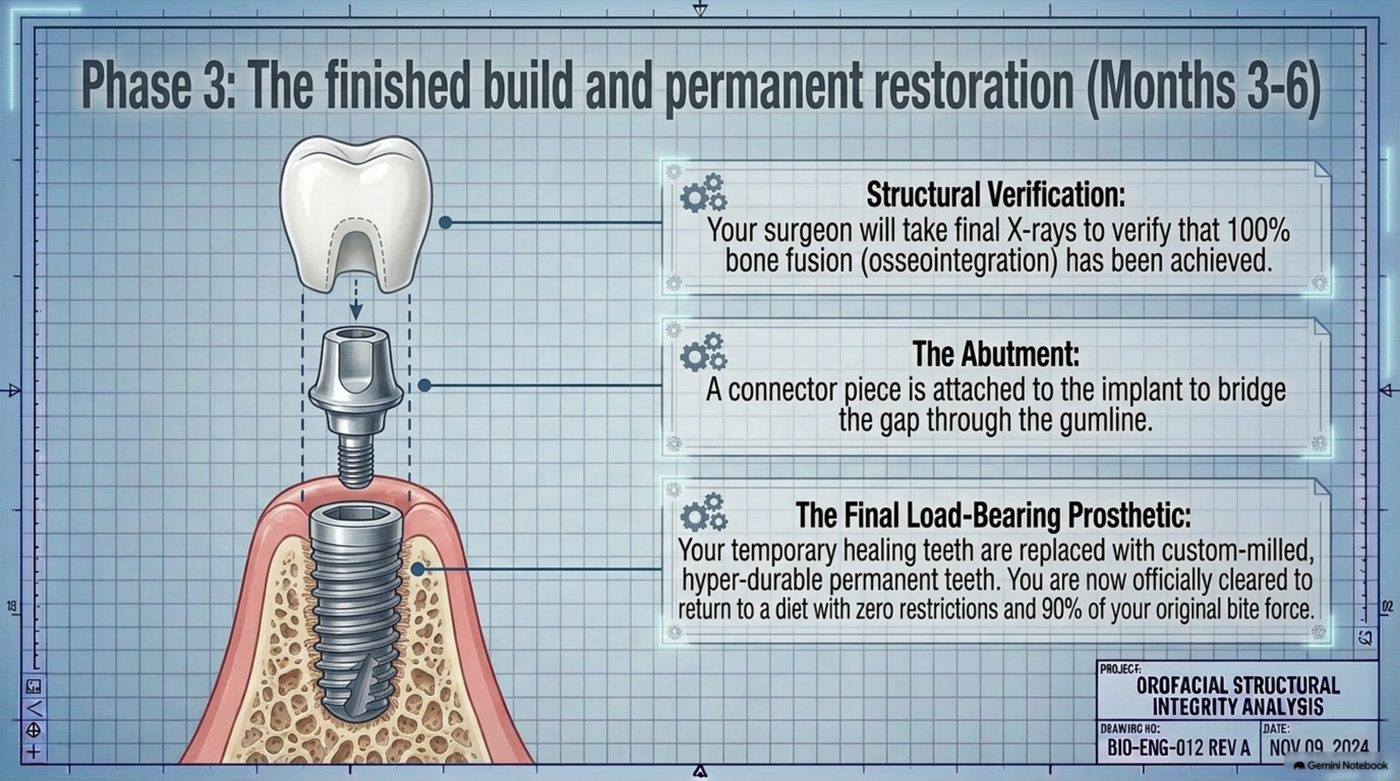
Months three to six are when a full-arch implant stops being a construction site and becomes a finished structure. Drawing BIO-ENG-012 breaks Phase Three into three events: structural verification, the abutment, and the final load-bearing prosthetic. Knowing what happens in each one explains what "signed off" means inside your jaw, and what changes the day the permanent arch goes in.
What Phase Three Actually Marks
Phase One placed the titanium posts. Phase Two let bone grow into them. Phase Three, running across months three to six, is where the structure is inspected, connected, and finally loaded. On an engineering drawing this is the handover: the foundation is verified, the pass-through is built, and the finished facade is mounted onto the frame. In a dental chair it feels far less dramatic, which is why it pays to know what is happening under the gum.
This phase is the last stop before the maintenance schedule that keeps the structure standing for decades. If you want the first half of the arc told from the symptom side, the site's dental implant recovery timeline tracks the same months through swelling, soft food, and healing.
Step One: Structural Verification
The first event of Phase Three is not dentistry. It is inspection. Your surgeon takes final X-rays to verify that 100% bone fusion, the process the deck calls osseointegration, has been achieved. Practically, that means reading the interface along the full length of every implant: healthy bone should sit in direct contact with the titanium threads, with no dark line around them. A visible gap is the X-ray signature of an interface that has not fused yet.
Verification is a pass-or-fail gate for a mechanical reason. If one section of an implant has fused and another has not, loading the arch would funnel the whole bite force through the fused portion alone, concentrating stress where the structure can least spread it. That is why this stage is measured in months rather than weeks. The sibling article on fusion versus friction fit explains the difference at the interface.
Step Two: The Abutment
Once the interface is confirmed, the second step begins. A connector piece, the abutment, is attached to the implant to bridge the gap through the gum line. Until this point the titanium post has been completely buried, protected by tissue. The abutment is the first part of the system to emerge into the mouth, and the component the finished arch bolts onto.
It is a small part with an outsized job. The abutment carries the angle of the arch, holds the height that keeps the prosthesis clear of the gum, and determines how easy the structure will be to clean. Placement is minor: the gum is opened briefly so the connector can be seated, followed by a short window of soft eating while the tissue closes around it.
Step Three: The Final Load-Bearing Prosthetic
The third step is what most people picture as the finish line. Your temporary healing teeth are replaced with custom-milled, hyper-durable permanent teeth. "Custom-milled" is not marketing language. A digital scan of the verified abutment positions drives the machining of an arch whose contact points, arch form, and bite height match the hardware genuinely in your jaw.
The temporary arch and the permanent arch are different engineering categories. The temporary is a scaffold: fitted to shape the gum and let you function socially while fusion finishes, but not built to take full load. The permanent arch is the load-bearing member, and it goes on only after the abutments pass verification. The sibling article on acrylic, nano-ceramic, and zirconia arch materials compares those options in detail.
What "Signed Off" Means Structurally
When a patient hears their case has been signed off, they usually translate it as "finished." Structurally it means something stricter, three conditions holding at once. The bone-to-implant interface has been verified at 100% fusion. The connector is installed and the gum has sealed around it. And a load-bearing arch has been seated onto the abutments, with that seating checked rather than assumed.
Only when all three are true is the load path from tooth to bone complete. Before that, an implant is a component sitting in a jaw. After it, the system can accept force the way it was designed to. Signed off is a statement about structure, not a mood.
The Day the Permanent Arch Goes In
This is the day the rules change. You are cleared for a diet with zero restrictions, from crusty bread to apples to a steak you no longer cut into timid pieces. You also have roughly 90% of your original bite force back. That figure deserves context: natural teeth sit in a cushioning ligament that absorbs shock, implants are rigid. A modest reduction is by design, and 90% is still more force than most full-denture wearers can generate. For the wider service picture, see the full mouth dental implants page.
| Phase Three step | What the deck says happens | What it changes |
|---|---|---|
| Structural verification | Final X-rays verify that 100% bone fusion (osseointegration) has been achieved | A green light to build; no loading before this point |
| The abutment | A connector piece is attached to bridge the gap through the gum line | A mount point for the finished arch |
| Final load-bearing prosthetic | Temporary healing teeth are replaced with custom-milled, hyper-durable permanent teeth | A diet with zero restrictions and 90% of original bite force |
Why the Temporary Arch Was Never the Destination
Temporary healing teeth exist to hold space, shape the gum, and let you look like yourself while bone finishes its work. They are replaced on schedule, and their job ends the moment the permanent arch begins. Treating the temporary as the finished product is a common misunderstanding that leads people to test limits it was never built to take.
Because Phase Three is sequential, it helps to track where you actually are. A structured All-on-4 recovery checklist keeps the milestones, diet rules, and clearance points in order so nothing gets rushed inside the chair.
Frequently asked questions
Does 100% bone fusion mean the implant is glued into the bone?
No. There is no adhesive anywhere in the system. Osseointegration is living bone growing into direct contact with the titanium surface, thread by thread, until the two behave as one structure under load. The 100% figure describes the extent of that contact along the implant, and it is exactly what the final X-rays are read for.
How does the abutment get attached if the implant is under the gum?
The gum is opened for a brief procedure so the connector can be seated onto the buried implant, then it heals closed around the new piece. Expect minor sensitivity for a few days and softer eating. The abutment is what remains above the gum line, and it is what the permanent arch attaches to.
Why only 90% of bite force instead of 100%?
Natural teeth are suspended in a ligament that cushions impact; titanium is not. The slight reduction is a designed buffer rather than a shortfall. At 90% you can eat anything you like, and that ceiling is part of what protects the implant-to-bone interface over years of use.
Phase Three is the shortest chapter in the whole process and the one that decides how the rest of it feels: a verified interface, a seated connector, a loaded arch. If you are weighing full-arch treatment in Cape Coral and want to compare local providers before you commit, get matched with Cape Coral providers free of charge and with no obligation, and bring the questions this article raised to the consultation.
This guide expands slide 13 of Engineered for Life: The Biomechanics and Economics of Dental Implants
For the complete slide-by-slide narrative, read the full deck walkthrough.