Protecting the Asset: Peri-Implantitis and the Tools That Prevent It
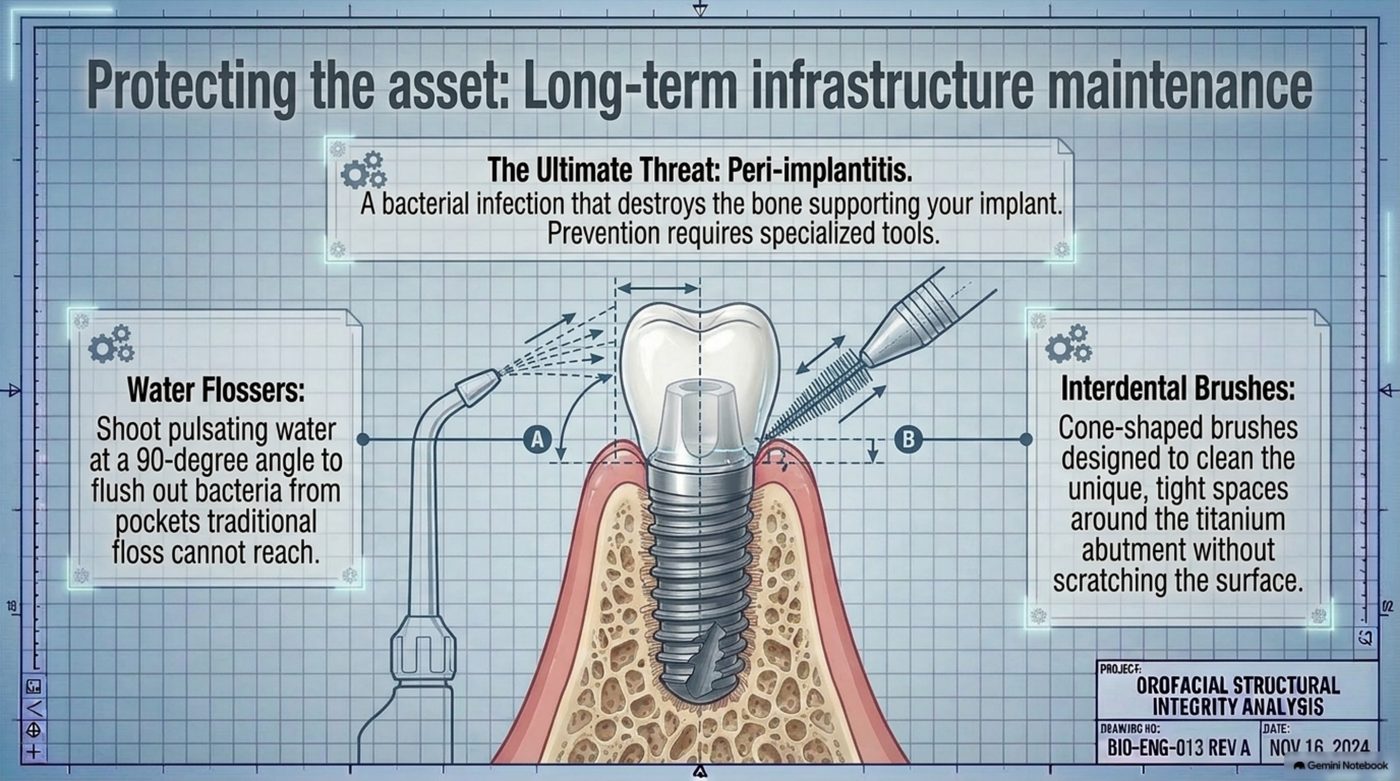
A full-arch restoration is the largest capital asset most people will ever have installed in their own body, and capital assets come with a maintenance schedule. Drawing BIO-ENG-013 names the threat in plain terms: peri-implantitis, a bacterial infection that destroys the bone supporting your implant. It also names the two specialized tools that hold that threat off, and neither of them is a standard toothbrush.
Maintenance Is Asset Protection, Not a Chore
Think of the finished arch the way the deck does, as infrastructure. The titanium posts and the bone fused to them are the foundation, and that foundation is the part of the system that cannot simply be swapped out. Everything you do afterwards with a water flosser or a small brush is maintenance on that foundation, and the entire purpose of maintenance is to protect the part that is hardest, and most expensive, to rebuild.
Implants also need a different routine than the one you learned for natural teeth. An implant has no periodontal ligament and far fewer nerve endings, so the early warnings that would normally make you flinch are not reliably there. A natural tooth hurts when something is going wrong. An implant frequently stays quiet until the problem has moved past the surface.
The Ultimate Threat: Peri-Implantitis
The deck is blunt about it. Peri-implantitis is a bacterial infection that destroys the bone supporting your implant. Notice what the target is. A cavity attacks enamel, which is damaging but confined. Peri-implantitis attacks the foundation itself, the same bone that spent months fusing to the titanium during osseointegration. Once that bone recedes, the implant loses the material it is anchored in, and no amount of re-tightening brings it back.
The general day-to-day list of habits, foods, and things to avoid at each stage is already covered in the site's article on dental implant care dos and don'ts. This article deliberately takes a different angle: the specific threat, and the two pieces of equipment the deck prescribes to counter it.
Tool One: The Water Flosser
Water flossers shoot pulsating water at a 90-degree angle to flush out bacteria from pockets traditional floss cannot reach. That 90-degree detail is the whole mechanism. The jet is aimed perpendicular to the gum line, straight into the crevice where the prosthetic meets the tissue, instead of being dragged along the surface. Pulsation does the rest, lifting and carrying away the biofilm that collects in that crevice.
String floss fails here for a structural reason. On a full arch there are no gaps between individual teeth to thread through, and the junction that genuinely needs cleaning sits between the prosthesis and the gum. There is nowhere for a strand to wrap. A directed jet reaches into the pocket instead, which is why the deck lists a water flosser as a specialized tool, not an optional extra.
Tool Two: The Interdental Brush
Interdental brushes are cone-shaped brushes designed to clean the unique, tight spaces around the titanium abutment without scratching the surface. The abutment is where the implant emerges through the gum, and it is the narrowest and most vulnerable zone in the whole assembly. A cone shape is what lets the brush taper into spaces a cylindrical brush cannot enter at all.
The "without scratching" clause matters as much as the shape. Titanium that has been scratched becomes a rougher surface, and a rougher surface is easier for bacteria to colonize and harder to keep clean. That is the reasoning behind using a purpose-made brush rather than a metal pick or anything improvised from a drawer: you are cleaning the asset, not scraping it.
The Monitoring Cadence
Tools only help if they are used on a rhythm. At home the cadence is daily: water flossing and interdental brushing around the abutments become part of ordinary hygiene rather than something saved for the weekend. At the professional end, every recall visit is where the structure is actually measured, with bone levels around the implant compared against the previous visit rather than judged on their own.
That comparison is the point. A single reading tells you where things stand; a series tells you which way they are trending. Stable numbers mean the asset is intact and the routine is working. A downward trend is the moment to change something, while the correction is still a cleaning protocol and not a rebuild. A structured peri-implantitis maintenance checklist helps you walk into each visit with the right questions and leave with a routine you will actually follow.
Reading the Warning Signs Early
Because implants report so little, you have to look rather than wait to feel. Bleeding when you clean, tenderness along the gum line, a persistent bad taste, or tissue that appears to be pulling away from the abutment are all reasons to call rather than to wait and see. Inflammation that stays at the gum level is manageable with hygiene changes. The same process allowed to reach the bone is the destructive version the deck warns about.
Early detection is also cheaper. A maintenance adjustment is a short appointment and a changed habit; rebuilding bone lost around an implant is a different category of treatment.
Where This Fits After the Build Is Signed Off
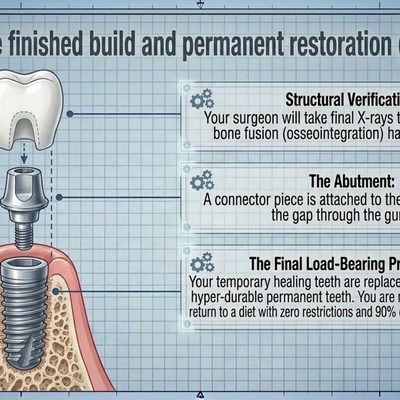
This routine starts the day Phase Three ends. Once the permanent arch has been verified, seated, and cleared for full loading, as described in the sibling article on the permanent restoration in the months three to six window, the case shifts from construction to operation. From that point on the structure is finished and the only variable left in its lifespan is how consistently it is maintained. The full drawing set, including BIO-ENG-013, is collected in the structural blueprint deck PDF.
| Threat or tool | What the deck says | Where it applies |
|---|---|---|
| Peri-implantitis | A bacterial infection that destroys the bone supporting your implant | The bone-to-implant foundation itself |
| Water flossers | Shoot pulsating water at a 90-degree angle to flush out bacteria | Pockets traditional floss cannot reach |
| Interdental brushes | Cone-shaped brushes that clean the surface without scratching it | The unique, tight spaces around the titanium abutment |
Frequently asked questions
Can I skip the water flosser if I brush thoroughly?
Brushing cleans the flat surfaces of the arch; it does not reach the pocket where the prosthesis meets the gum, which is the zone the deck singles out. Because traditional floss has no continuous gap to thread through on a full arch, the pulsating jet is doing a job the brush cannot do. The two are complements, not substitutes.
Will an interdental brush damage the implant or the abutment?
Not when it is the purpose-made cone-shaped brush the deck describes. The design is specifically intended to clean the tight spaces around the titanium abutment without scratching the surface. Abrasive or improvised tools are the risk, because a scratched titanium surface gives bacteria somewhere to settle and is harder to keep clean afterwards.
How would I know peri-implantitis is starting?
Look for bleeding when you clean, tenderness along the gum line, a bad taste, or tissue appearing to pull away from the abutment. Because implants have few nerve endings, discomfort often arrives late, so bleeding during hygiene plus a change in the numbers at your recall visits are the earliest reliable signals that something needs attention.
An implant system is engineered to last, but engineering only gets you the structure. Maintenance is what keeps the foundation under it. If you are planning full-arch treatment in Cape Coral, get matched with Cape Coral providers free of charge and with no obligation, and ask them to walk you through the long-term maintenance routine on the same day you review the treatment plan.
This guide expands slide 14 of Engineered for Life: The Biomechanics and Economics of Dental Implants
For the complete slide-by-slide narrative, read the full deck walkthrough.