Friction vs. Fusion: What Osseointegration Actually Does to Titanium
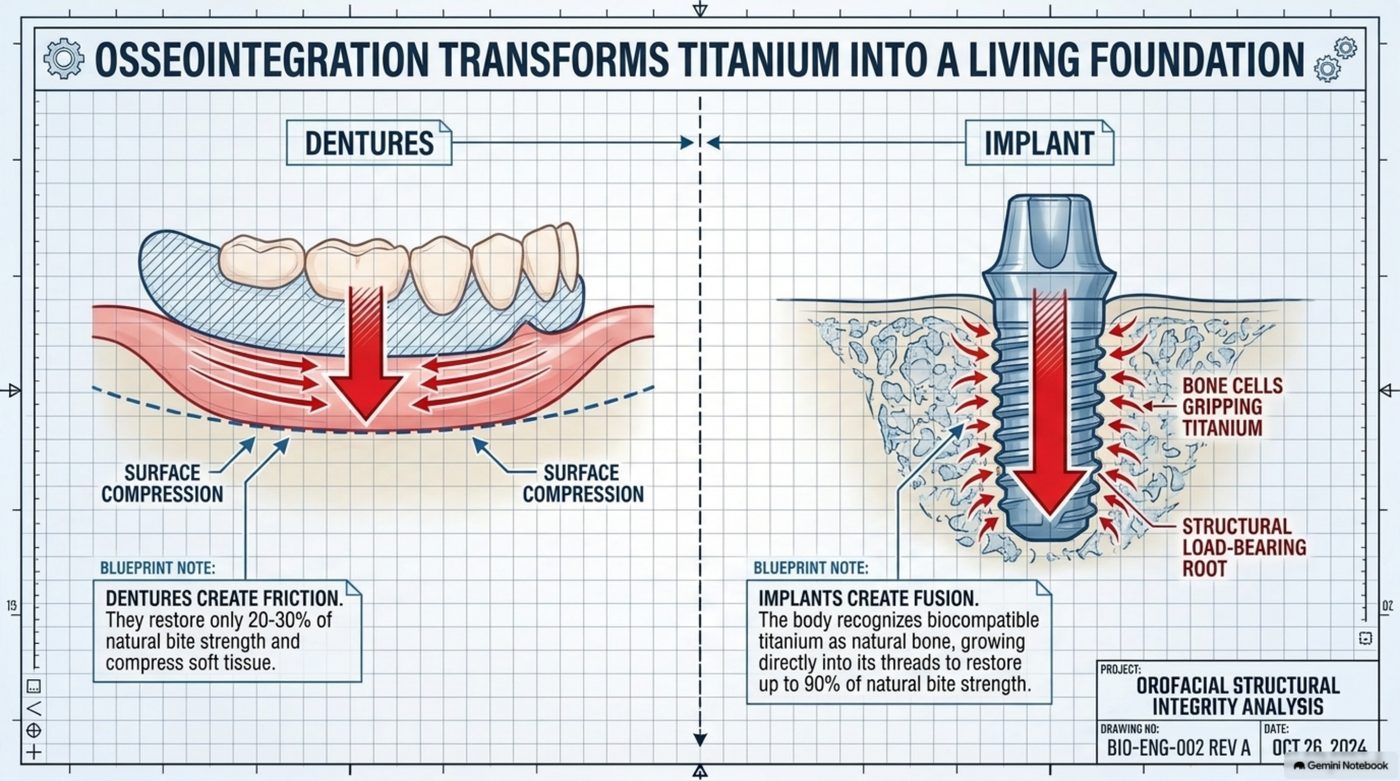
Drawing BIO-ENG-002 compresses the whole case into two annotations: dentures create friction, implants create fusion. One presses against soft tissue and returns only 20-30% of natural bite strength. The other persuades living bone to grip a titanium post directly and gives back up to 90%. The distance between those numbers is not a marketing claim, it is a description of two different load paths through the same jaw.
Two Ways to Send Force Through a Jaw
Every bite is a load event. Force starts at the food, travels through the tooth, and has to be discharged into the skull somewhere. A natural root passes that load straight into bone through a structure shaped for exactly that job. A denture never reaches bone at all. It rests on the gums, and gum is a soft, blood-rich cushion that was never designed to take chewing force. That single difference in the load path, not materials or price, separates the two columns of the drawing.
Friction: The Denture Load Path
Bite down on a denture and the force enters the base, spreads into the gum, crosses soft tissue, and only then reaches the ridge. Because the appliance is held by suction and adhesion, the moment the jaw delivers real force it shifts. The blueprint note names the result without softening it: dentures create friction. That friction concentrates at the ridge, and it explains the sore spots, the rocking motion, and the slow change in the profile of the lower face over the years.
This is not a fitting problem a better denture solves. Any appliance that depends on contact with the gum loads the same soft surface, however carefully it was made, which is why the deck measures the denture column against the implant column rather than against other dentures.
What 20-30% Actually Buys You
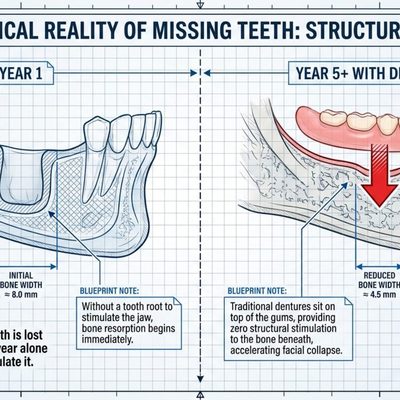
The drawing rates denture bite strength at 20-30% of natural. In practice that means crusty bread, raw vegetables, and apples become careful choices, and patients learn to chew on the side that hurts least. The number matters because it is structural, not merely a comfort figure. A jaw that only ever receives a fifth to a third of the load it was built for has stopped being asked to work, and bone that is not loaded is bone the body recycles. That is the mechanism behind ridge shrinkage, and the deck files soft-tissue compression under engineering failure.
Fusion: Bone Cells Gripping the Titanium Surface
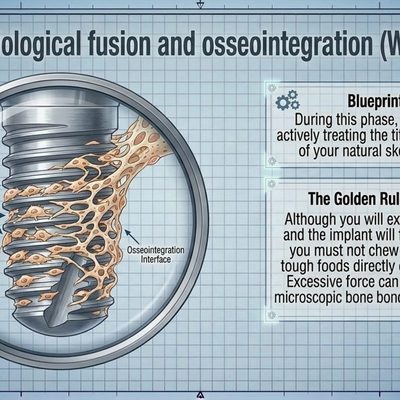
The implant column of BIO-ENG-002 shows something a denture cannot. Bone cells are drawn gripping the threaded titanium surface, and the annotation states that the body recognizes biocompatible titanium as natural bone and grows directly into its threads. That is osseointegration, and it is a biological decision rather than a mechanical one. The bone is not tolerating the metal, it is treating it as part of the skeleton, and a structure the jaw actively maintains is one it will not dissolve away.
Titanium earns that response because it is biocompatible: the immune system does not wall it off the way it would a foreign body. Bone-forming cells migrate to the surface, latch on, and mineralize into the threads. The article on the weeks of osseointegration follows that process on a calendar; the compact version is that the denser the grip, the more load the finished restoration can carry.
Compression Versus a Structural Load-Bearing Root
The two annotations under the drawings are not decoration. A denture applies surface compression: every bite is a push against tissue that rebounds, so the load spreads across a soft surface that deforms under it and springs back when pressure stops. An implant is a structural load-bearing root. Force enters the restoration, travels down the post, and is delivered into dense bone the way a foundation delivers a building's weight into soil. A cushion absorbs and returns energy. A foundation carries it permanently.
That distinction also explains why the bone reacts in opposite directions. Compression against gum asks nothing of the bone beneath it, and unasked bone recedes. Load through an integrated root asks a great deal, and bone answers by staying dense. If you want that recession quantified, the jawbone atrophy timeline covers how much width is lost and at what stage.
Why Fusion Is a Permanent Foundation
Permanence here is not a warranty claim, it is a statement about where the load terminates. When bone grows directly into the threads, implant and jaw become one continuous structure with no soft interface to wear out: no base to loosen, no adhesive to refresh, no ridge to lose. The 90% bite strength figure describes a load path that ends in bone rather than in tissue, and bone that is loaded keeps its density instead of being resorbed. Fusion delivers load, load preserves bone, and preserved bone holds the fusion.
| Load path | Dentures | Implants |
|---|---|---|
| What carries the force | Soft tissue and gum | Bone, through the threaded post |
| Natural bite strength restored | 20-30% | Up to 90% |
| Interface with bone | Surface compression | Bone cells gripping the titanium surface |
| Structural role | Covers the ridge | Structural load-bearing root |
| Deck annotation | Dentures create friction | Implants create fusion |
| Source drawing | BIO-ENG-002 REV A, Oct 26 2024 | BIO-ENG-002 REV A, Oct 26 2024 |
What This Means for Your Own Decision
If you are comparing quotes, compare them in the currency the deck uses: what will your jaw be asked to carry, and by what. A plan that ends with gum bearing the load produces a different twenty years than one that ends with bone bearing it. Where your case lands depends on bone width, bone density, and how long you have worn an appliance that compresses tissue instead of loading it. The combined slide walkthrough places this drawing in sequence, between the atrophy panel before it and the healing phases after.
That is also what the implant success and risk profile is for. It walks through the variables a surgeon weighs, in plain language, so you arrive at a consultation knowing which of them apply to you.
Frequently asked questions
Is osseointegration painful while it happens?
No. The process itself is microscopic and quiet. What patients feel is recovery from the surgery, which is a separate event with its own symptoms and its own schedule. By the time bone is actively growing into the threads, most people describe the site as feeling entirely normal, which is why the deck warns against testing it with hard food too early.
Does titanium ever come loose from the bone once it fuses?
Fusion is the goal precisely because it is durable. Once bone has grown into the threads, the implant is part of the skeleton rather than an object resting inside it. The remaining threats are hygiene problems, not mechanical loosening, which is why maintenance matters more than caution. A clean, loaded, fused implant is the most stable structure the deck describes.
So are dentures ever the right choice?
They can be, for some patients, and nothing here rules them out. The deck's point is narrower: a denture is a compression device and should be understood as one. It returns 20-30% of natural bite strength and does not stimulate the bone beneath it. If those trade-offs are acceptable, that is a legitimate decision. If not, the rest of the drawings are where the alternatives begin.
Whichever way you are leaning, the useful next step is an evaluation with your own numbers in front of you. Cape Coral providers listed on this site offer that at no cost and no obligation, and you can get matched with Cape Coral providers to start.
This guide expands slide 03 of Engineered for Life: The Biomechanics and Economics of Dental Implants
For the complete slide-by-slide narrative, read the full deck walkthrough.