Structural Atrophy: How Much Jawbone Do You Lose Without a Tooth Root?
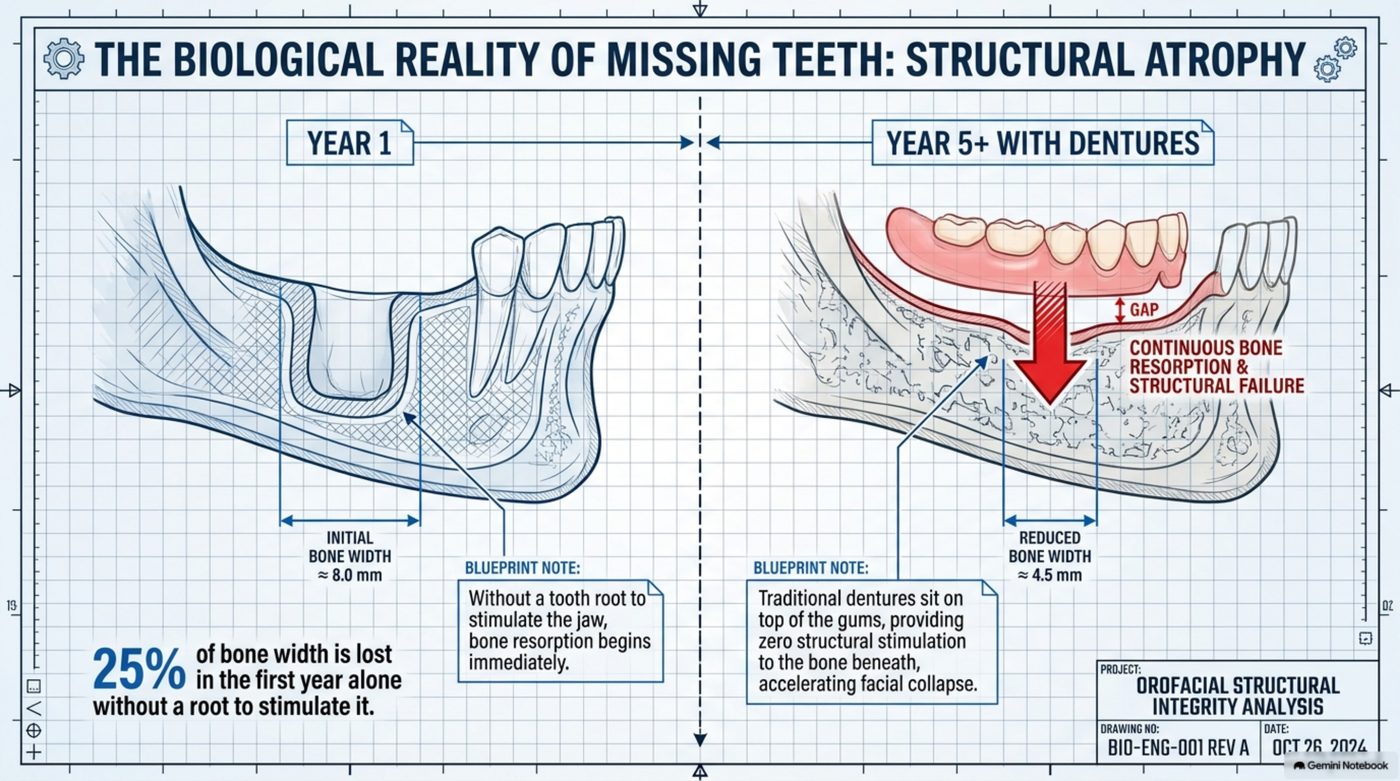
A missing tooth stops being a local problem the moment you look at the bone around it. Without a root driving force into the jaw, the ridge begins to shrink almost immediately, and slide two of the "Engineered for Life" deck makes that shrinkage uncomfortably specific: roughly 8.0mm of bone width to begin with, about 4.5mm after years of wearing dentures, and a quarter of the width gone inside the first year alone. This is what structural atrophy looks like on a timeline.
The Clock Starts the Day the Root Leaves
Bone is not an inert frame that stays wherever it was built. It is living tissue that renews itself in response to load, adding density where force arrives and removing it where force stops. A tooth root is one of the most efficient load-delivery devices in the body: every bite sends pressure down through it and out into the surrounding bone, and that pressure is the signal the bone uses to keep itself.
When the root is extracted, the signal leaves with it. The jaw does not wait for a convenient moment to respond. As the slide's blueprint note puts it, bone resorption begins immediately, and it begins along the ridge that used to support the tooth.
Measuring the Loss: 8.0mm, Then 4.5mm
Slide two draws the same cross-section at two points in time and labels both. The initial bone width is marked at roughly 8.0mm. The reduced bone width, shown for year five and beyond in a patient wearing traditional dentures, comes in at about 4.5mm. Two drawings, separated by a gap that widens every year nobody intervenes.
The slide also calls out the steepest part of that curve, noting that 25% of bone width is lost in the first year alone when there is no root to stimulate the jaw. The ridge does not decline gently and at an even rate. It drops sharply first, then keeps falling, which is why the drawing is stamped and numbered like a survey of a failing structure rather than a diagram of a cosmetic change.
Why Dentures Do Not Stop the Resorption
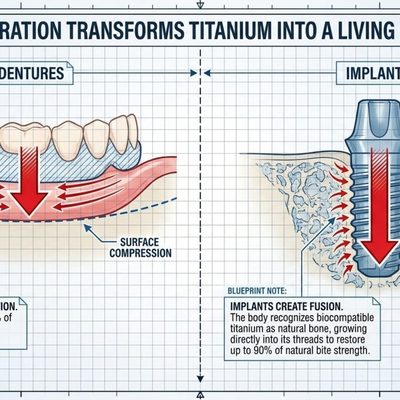
This is the part of the slide most patients have never heard stated plainly. A traditional denture sits on top of the gums, and the note beside the drawing says exactly what that means: it provides zero structural stimulation to the bone beneath. The appliance covers the ridge, presses on the soft tissue over it, and sends no load into the bone itself, which is the one thing the bone needs in order to stay.
Worse, the pressure of a denture against the gum can speed the process along rather than pause it. The ridge shrinks, the denture loosens, the denture is relined, and the ridge shrinks further. The slide names where that loop ends: accelerating facial collapse, driven by the very appliance meant to stand in for the missing teeth.
What Stimulation Means in Structural Terms
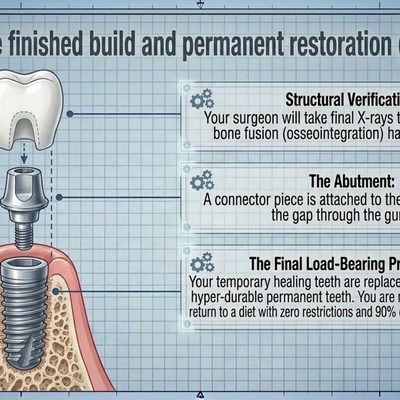
Stimulation is not a vague benefit. When an implant is placed, load travels through the biting surface, down the implant body, and into the bone along the interface, and the bone answers by keeping itself dense around that interface. That response is osseointegration: the union of living bone with a titanium surface, where the body treats the post as part of the skeleton and maintains it accordingly.
A denture produces friction against soft tissue. An implant produces fusion with hard tissue. Only one of those two relationships gives the bone a reason to stay where it is, and the timeline on slide two is simply what happens when the bone never receives that reason.
The Bone Width Timeline at a Glance
Pulled off the drawing and laid out in order, the sequence reads like this.
| Stage | Ridge width | What is happening |
|---|---|---|
| Initial bone width | ≈8.0mm | Root present, load reaches the bone and maintains it |
| First year without a root | 25% of width lost | Resorption begins immediately, before any denture is fitted |
| Year 5+ with traditional dentures | ≈4.5mm | Dentures rest on the gums and add no structural stimulation |
When There Is Not Enough Bone Left
Once width has fallen from 8.0mm toward 4.5mm, the problem is no longer abstract. An implant needs enough bone to surround it and enough clearance from structures such as the nerve canal, and a narrow, resorbed ridge may offer neither. That is where bone grafting enters the plan: rebuilding the foundation before the implant is placed rather than compromising the implant to fit a ridge that is no longer adequate.
The further resorption has gone, the more of the plan that step tends to absorb, which is the most practical argument for evaluating replacement sooner rather than later. If you want to see how a ridge trends over five, ten, or twenty years, the jawbone loss estimator walks the same curve this slide draws.
What This Means Before You Choose
Two conclusions follow from the drawing, and neither one requires an engineering background. First, the clock on bone loss starts at extraction, not at the moment you decide to do something about it, so the question of what replaces the tooth is also a question about how much foundation will remain when you answer it. Second, the appliance decision and the bone decision are the same decision, because a solution that sends load into the bone preserves it while a solution that rests on the gums does not.
For patients weighing the broader set of options, the full mouth dental implant path is compared against removable alternatives on slide five, and the complete walkthrough covers every slide in order if you would rather follow the argument from the start.
Frequently asked questions
Does bone loss really start immediately after a tooth comes out?
The slide's blueprint note says it does. Without a tooth root stimulating the jaw, resorption begins right away, and 25% of bone width is lost within the first year alone. The decline is fastest early and continues for as long as the ridge goes unloaded.
Can dentures stop the bone from shrinking?
No. Traditional dentures sit on top of the gums and provide zero structural stimulation to the bone beneath. Because the load never reaches the ridge, the bone has no reason to maintain itself, and an appliance that replaces the teeth does not replace the function they performed.
How much bone width is left after years of wearing dentures?
The slide shows an initial width of roughly 8.0mm and a reduced width of about 4.5mm by year five and beyond with dentures. That is roughly the difference between a ridge that can host an implant without extra work and one that may need grafting first.
Structural atrophy is quiet. It produces no pain, no visible symptom, and no urgent appointment, which is exactly why it runs for years before anyone treats it as the engineering problem it is. The two drawings on this slide are the same patch of jaw at different points in that process, and the gap between them is the cost of waiting. If you want to know where your own ridge sits on that curve, the practical first step is a measurement, and matching with local Cape Coral providers who can take it is free. Get matched with Cape Coral providers when you are ready.
This guide expands slide 02 of Engineered for Life: The Biomechanics and Economics of Dental Implants
For the complete slide-by-slide narrative, read the full deck walkthrough.